.png)


.png)
Summary
- A bad hire costs an average of $17,000, often due to unconscious biases in traditional interviews that favor candidates based on "gut feel" rather than skill.
- AI-driven assessments counter common hiring biases by standardizing evaluations, ensuring every candidate is judged on their actual selling abilities in realistic simulations.
- To be effective and fair, AI tools must be carefully calibrated and used as a co-pilot to augment human judgment, not as an autopilot to replace it.
- Companies can reduce hiring mistakes and build stronger teams by using AI Roleplay Hiring Assessments to objectively identify top sales talent early in the process.
You've spent hours preparing for that sales interview. You've researched the company, practiced your pitch, and polished your resume. Then they hit you with it: "Please complete this online assessment before we proceed."
Your heart sinks. "I feel like they are already pre-programming me to be a sales robot before the interview even starts," you think. And that six-round interview process? It "definitely puts a sour taste in my mouth from the jump."
If this resonates with you, you're not alone. But what if the real problem isn't the assessment itself, but rather the human biases lurking beneath traditional interview processes?
The Hidden Cost of Hiring Bias
Let's talk numbers: A bad hire costs companies an average of $17,000, with total costs reaching up to three to four times the position's salary. Managers waste approximately 26% of their time coaching inadequate hires instead of driving revenue.
But the most alarming statistic? Resumes with white-sounding names receive 9% more callbacks than those with Black-sounding names, according to NPR research. This isn't just an ethical issue—it's a business problem that costs organizations talent, time, and treasure.
The irony? Those "dehumanizing" AI assessments might actually create a fairer, more objective, and ultimately more respectful hiring process than traditional methods.
The Hidden Biases That Sabotage Your Sales Interviews
Before we explore how AI can help, we need to understand what we're fighting. Interviewer bias occurs when an interviewer judges a candidate based on unspoken and unconscious criteria, leading to subjective evaluations of skills and competencies.
According to research from AIHR, here are some of the most common biases that plague sales hiring:
.png)
- Similar-to-me Bias: "She's a Wildcats alum like me? Instant connection!" Favoring candidates who share your background or interests creates a team of clones rather than a diverse talent pool.
- Halo Effect: When a candidate's strong communication skills lead you to assume they're equally strong in pipeline management and forecasting.
- First Impression Bias: Making snap judgments based on handshakes and small talk rather than qualifications.
- Contrast Effect: Rating the current candidate against the previous one instead of against consistent job criteria.
- Stereotyping: Assuming all candidates from a particular group share the same characteristics. "He's from the tech sector, so he's probably not good at relationship selling."
These biases don't just hurt candidates—they hurt companies by screening out potentially excellent salespeople who don't fit a preconceived mold.
How AI Assessments Work: From Subjective Resumes to Objective Simulations
So how do AI sales assessments actually work? Instead of relying on subjective impressions, platforms like Hyperbound use AI to create standardized scenarios that measure actual selling skills. This process often looks like this:
.png)
- Publish Job & Explain Process: Transparency from the start helps candidates understand what to expect.
- Conduct Initial Phone Screenings: A brief human touchpoint qualifies interest and answers questions.
- Automated AI Assessment: A 15-minute AI-driven assessment is sent to all qualifying candidates.
- Realistic Sales Simulations: Candidates engage in scenarios like cold calling an AI agent, handling objections, or drafting a prospecting email.
- Automated, Unbiased Scoring: The AI scores performance based on predefined, calibrated criteria such as clarity, objection handling, and relevance.
- Data-Driven Shortlisting: Recruiters review objective results to select the top performers.
- Strategic Human Interviews: The sales team interviews a smaller, highly-qualified pool, focusing on strategy, team dynamics, and cultural fit.
This isn't just theoretical. Candidates rate these AI processes highly for fairness (4.3/5) and job relevance (4.5/5). One company saved over 1,500 collective hours in just three months.
Dismantling Bias, One Algorithm at a Time
What makes AI assessments particularly powerful is how they directly counter specific biases:
.png)
As one Reddit user candidly put it: "I don't mind the personality assessment, it's the criteria assessment that bothers me and I think it's unfair." The key difference with AI assessments is that they're designed to be consistently fair to everyone, not just candidates who match the interviewer's unconscious preferences.
The Elephant in the Room: Can We Trust the AI?
Let's address the critical counterargument: AI is not inherently fair. In fact, poorly designed AI can inherit and amplify human biases if not carefully managed.
According to Harvard Business Review, AI can "reshape fairness definitions, locking in one interpretation" if not thoughtfully implemented. With approximately 88% of companies already using some form of AI in hiring, this is a pressing issue.
Before implementing AI assessments, leaders must ask:
- What definitions of fairness exist within our organization? Is it pure consistency, or is there room for context?
- Who gives AI the authority to define "fair"? Recognize that humans embed their own priorities into the system.
- What version of fairness does our AI strengthen? Does it exclude high-potential outliers by enforcing a rigid score threshold?
Best Practices: Implementing an AI Assessment Process That's Fair and Effective
For companies looking to implement AI assessments while avoiding potential pitfalls, here are actionable guidelines:
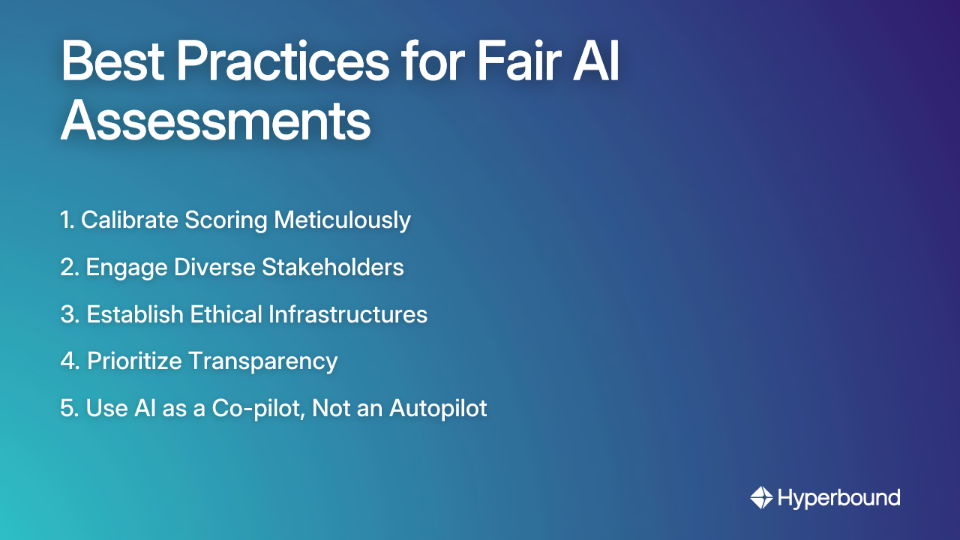
- Calibrate Scoring Meticulously: The scoring system must be fine-tuned to reflect the actual skills needed for the role, informed by data from current high-performing employees. Skaled's AI Sales Assessment Impact Report recommends aligning your assessment criteria with specific business goals and tracking success metrics.
- Engage Diverse Stakeholders: Involve HR, sales leaders, and frontline managers from design to implementation. This prevents the AI from operating in a vacuum and helps capture nuanced insights about what makes someone successful in your specific sales environment.
- Establish "Ethical Infrastructures": Create formal review processes and "debate clubs" to facilitate ongoing discussions about the AI's role. This ensures fairness remains a living concept, not a static rule set in code.
- Prioritize Transparency: Be upfront with candidates about how and why AI is being used in the process. Explaining the benefits—objectivity and fairness—can help address the concern that AI assessments feel dehumanizing.
- Use AI as a Co-pilot, Not an Autopilot: Position the technology as a tool to surface the most qualified candidates, but always retain human oversight and judgment for the final hiring decision. The Forbes Human Resources Council emphasizes that AI should complement, not replace, human decision-making.
Making the Human Connection More Meaningful
The frustration expressed by candidates—"What the fuck is up with these assessments and 6 rounds of interviews"—often stems from processes that feel both dehumanizing AND biased. That's the worst of both worlds.
But there's a powerful reframe: AI assessments, when properly designed, handle the repetitive and bias-prone task of initial screening. This actually frees up human interviewers to have more substantive, strategic, and ultimately more human conversations with a pool of candidates who have already proven they can do the job.
Instead of six rounds of inconsistent interviews where each person asks the same basic questions, imagine a process where:
- An AI assessment confirms you have the fundamental skills for the role
- Human interviewers then focus on deeper strategic thinking, team dynamics, and alignment with company mission
This approach respects candidates' time by ensuring they're only asked to invest in further interviews if they have a real chance at the job. And it respects their humanity by ensuring they're evaluated on their actual skills rather than arbitrary factors like which interviewer they happened to be assigned to.
The goal is not to turn candidates into "sales robots" but to ensure everyone gets a fair shot at showing what they can do. In a world where research shows that diversity in the candidate pool dramatically increases hiring diversity, AI assessments can help create that diverse pool by removing initial screening biases.
Done right, AI doesn't make hiring less human—it makes the human parts of hiring more meaningful, fair, and focused on what really matters: finding the right person for the job, regardless of who they are or who they know.
And that's something both candidates and companies can get behind.
Frequently Asked Questions
What is an AI sales assessment?
An AI sales assessment is a tool that uses artificial intelligence to evaluate a sales candidate's skills through standardized, simulated scenarios. Instead of relying on resume keywords or subjective interviews, these platforms measure practical abilities like cold calling, objection handling, and communication in a controlled, unbiased environment.
Why are companies using AI assessments in their sales hiring process?
Companies use AI assessments primarily to reduce costly hiring mistakes and combat unconscious bias in the traditional interview process. By standardizing the initial screening, organizations can objectively identify top performers based on actual skills, leading to a fairer process, a more diverse talent pool, and significant time savings for hiring managers.
How exactly do AI assessments help reduce hiring bias?
AI assessments reduce hiring bias by standardizing the evaluation process for all candidates. They use a consistent, pre-defined scoring rubric to evaluate performance in simulations, which eliminates subjective "gut feelings" and first impression bias. Furthermore, by focusing on skills demonstrated in anonymized scenarios, they counter biases like the "similar-to-me" effect and stereotyping based on a candidate's background.
Can AI hiring tools be biased themselves?
Yes, AI hiring tools can inherit and even amplify human biases if they are not designed and managed carefully. An AI is only as fair as the data and criteria it's trained on. To prevent this, it's critical to meticulously calibrate the AI's scoring system, involve diverse stakeholders in its implementation, and maintain human oversight to ensure the definitions of "fairness" and "success" are appropriate and equitable.
What specific sales skills do these AI assessments typically evaluate?
AI sales assessments are designed to measure core, on-the-job selling competencies. This often includes a candidate's ability to handle realistic sales simulations such as making a cold call to an AI agent, navigating common customer objections, demonstrating product knowledge, asking effective discovery questions, and drafting clear, persuasive prospecting emails.
Will AI assessments completely replace human recruiters and interviewers?
No, the goal of AI assessments is not to replace human involvement but to make it more meaningful and strategic. AI acts as a co-pilot, handling the initial, repetitive screening to identify a shortlist of highly qualified candidates. This frees up human interviewers to focus on deeper conversations about strategy, cultural fit, and team dynamics, ensuring the final decision remains in human hands.
What are the best practices for implementing a fair AI assessment process?
To implement a fair AI assessment process, companies should calibrate the scoring system against the skills of current top performers, ensure transparency by explaining the process to candidates, and establish ethical review protocols. Most importantly, AI should be used as a tool to augment human judgment, not replace it, with humans making the final hiring decision based on a combination of AI-driven data and in-person interviews.
Book a demo with Hyperbound


