.png)


.png)
Summary
- Neglecting sales coaching costs the average dealership over $1M in untapped gross profit annually and contributes to a 46% turnover rate, costing an additional $500,000 each year.
- The primary issue is promoting top salespeople into management roles without training them to coach, leading to a focus on putting out fires rather than developing skills.
- Implement a structured coaching blueprint: establish a daily 15-minute coaching rhythm, conduct weekly one-on-ones, and lead with empathy to foster trust and self-evaluation.
- Leverage AI-powered tools to scale coaching efforts; platforms like Hyperbound's AI Sales Roleplays provide reps with hyper-realistic practice and objective feedback to accelerate skill development without manager burnout.
You've seen it before. It's 8:30 on a Saturday morning, and your sales team is shuffling into another mandatory meeting. Some are nursing coffee cups, others checking their phones—thinking about the birthday party they missed last night or the family time they're sacrificing today. The energy is low, turnover is high, and despite everyone's hard work, your gross profit margins are shrinking as the market normalizes post-pandemic.
But what if the real problem isn't your sales team's effort? What if it's how they're being led?
At dealerships across America, a troubling pattern persists: top-performing salespeople get promoted to management positions without any training on how to actually coach others to success. The result? A crippling cycle of inconsistent performance, plummeting morale, and a revolving door of talented staff that's bleeding your dealership dry.
This article breaks down the staggering cost of neglecting sales coaching in your dealership, identifies the common barriers your managers face, and provides a clear, actionable blueprint for building a coaching culture that drives measurable results in revenue, retention, and team satisfaction.
The Bleeding Neck Problem: The Real Cost of Ineffective Coaching
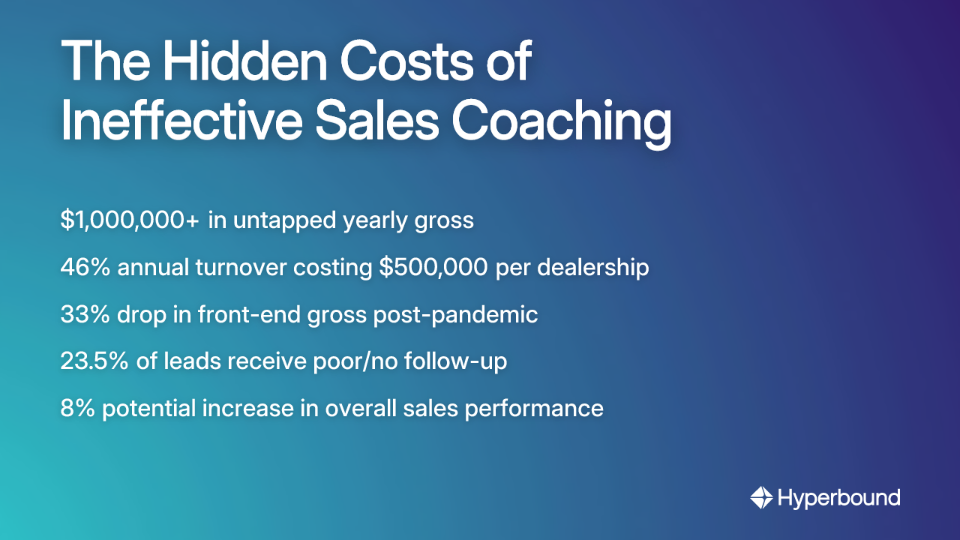
The financial impact of poor coaching isn't just significant—it's potentially catastrophic for your dealership's long-term health. Let's put some hard numbers to the problem:
The Million-Dollar Leak
Even small improvements in coaching effectiveness can yield massive returns. According to research from Automotive Sales Coach, a well-coached team can generate an additional $1,000,000 in yearly gross with no extra expenses. Just let that sink in—seven figures of untapped potential sitting in your existing team.
The Revolving Door Drain
The automotive industry suffers from a crippling 46% annual employee turnover rate, costing the average dealership over $500,000 each year in recruitment, training, and lost productivity. This isn't just a statistic—it represents broken customer relationships, lost expertise, and the constant drain of resources into onboarding new staff who may not stay long enough to become truly profitable.
The Gross Profit Nosedive
As inventory normalizes post-pandemic, dealerships are experiencing a 33% drop in front-end gross. Even more alarming, a shocking 23.5% of leads receive poor or no follow-up, representing thousands in lost potential revenue every month. This isn't a market problem—it's a coaching problem.
The Cultural Ripple Effect
Research from Gartner shows that effective coaching can increase overall sales performance by 8%, while its absence creates a toxic environment where:
- Top performers leave for better opportunities
- Mid-level performers stagnate without guidance
- New hires fail to develop consistent sales processes
- Customer experience suffers from inconsistent interactions
The question isn't whether your dealership is losing money from ineffective coaching—it's how much you're losing and how quickly you can stop the bleeding.
Why Good Salespeople Make Bad Coaches (Without the Right Support)
Before blaming your sales managers, it's important to understand the systemic challenges they face. Most were promoted because they could sell—not because they could teach others to sell.
The Overwhelm of the Manager Role
Your sales managers are drowning in administrative tasks. Between forecasting, reporting, desk deals, and putting out daily fires, coaching gets pushed to the back burner. According to Integrity Solutions, time constraints are the number one barrier preventing effective coaching. When everything is urgent, development becomes optional.
The Critical Skill Gap
Here's an uncomfortable truth: 69% of sales training reinforcement is supposed to come from managers, yet most have never been trained to coach effectively. They're expected to develop others without having that skill developed in themselves first.
Even more concerning, 50% of organizations struggle to even identify who needs coaching, revealing a fundamental misunderstanding of coaching's purpose. Your managers might not know where to begin or how to approach different team members with varying needs.
Confusing Coaching with Performance Management
Many managers treat "coaching" as code for "let me tell you what you're doing wrong." They schedule sessions to review numbers, point out failures, and issue directives. This creates a fear-based environment where salespeople hide their weaknesses instead of seeking help to improve.
As one dealership sales manager admitted in a Reddit discussion: "It's a commitment and you will miss holidays, birthdays, forgo the Friday night out drinking because you have an 8:30 Saturday am sales meeting." This high-pressure environment without proper support creates burnout on both sides.
The Post-COVID Sales Hangover
The pandemic created a seller's market where vehicles practically sold themselves. Now, according to Automotive Sales Coach, salespeople are "starting deals at the end," skipping crucial value-building steps because they didn't need them during the shortage.
Your managers are too focused on the final numbers to correct the broken process, creating a cycle of diminishing returns as market conditions normalize.
The Dealership Coaching Blueprint: A Step-by-Step Guide
Now for the good news: transforming your sales managers into effective coaches doesn't require a complete overhaul of your dealership. What it needs is a structured approach that any manager can implement immediately.
Part 1: Foundational Principles
Lead with Empathy and Foster Trust
Coaching isn't about commanding; it's about connecting. The best coaches create psychological safety where salespeople feel comfortable admitting struggles.
Start by having managers share their own challenges and failures. This vulnerability builds trust and makes reps more receptive to feedback. When a salesperson believes their manager genuinely wants them to succeed, they'll be more open about areas they need help.
Protect Your Team's Well-being
The car business is notoriously brutal on mental health. With 70% of sales professionals struggling with mental health issues according to the 2024 State of Mental Health in Sales report, coaching must address the whole person.
Set clear boundaries around work hours when possible, encourage time off, and normalize conversations about stress management. A burned-out salesperson can't perform, no matter how well you coach their closing techniques.
Part 2: The Coaching Rhythm
Implement a Daily System
Effective coaching isn't a monthly event—it's a daily practice. The good news? It only takes 15 minutes daily for training and huddles to create momentum.
Use a structured approach like the 10 Daily Habits system recommended by Automotive Sales Coach. This provides clear expectations and accountability, increasing team engagement by 85-90% within 60 days.
Your daily rhythm might include:
- Morning huddles to set priorities
- Quick role-playing sessions for specific scenarios
- End-of-day debriefs to reinforce learning
Prioritize One-on-One Time
While group training has its place, real growth happens in personalized sessions. Shockingly, only 26% of sales reps receive weekly one-on-one coaching, according to industry research.
Schedule 30-minute weekly sessions with each team member, focusing on one improvement area at a time. As advised by sales coaching experts, trying to fix everything at once overwhelms reps and diminishes results.
Part 3: The Coaching Conversation
Step 1: Promote Self-Evaluation
Instead of telling a rep what they did wrong, ask them to assess their own performance. Questions like:
- "How do you think that customer interaction went?"
- "What would you do differently next time?"
- "Where in the process did you feel things shift?"
This builds self-awareness and confidence, empowering the rep to own their development.
Step 2: Create a Documented Action Plan
Turn conversation into commitment. Have the rep create and document a specific action plan with achievable steps and timelines. This fosters ownership and accountability.
The plan should include:
- The specific skill to improve
- How success will be measured
- What support the manager will provide
- Timeline for check-ins
Step 3: Regular Follow-Ups
Maintain momentum with ongoing check-ins to assess progress and adapt the plan. These follow-ups show your commitment to the rep's growth and reinforce the importance of the coaching process.
Part 4: Leveraging Technology
Use Data, Not Guesswork
Modern CRMs and sales tools provide rich data about your team's performance. Use these insights to focus coaching efforts where they'll have the greatest impact.
Effective coaches focus on the quality of activities, not just volume. Are your reps having meaningful conversations or just logging calls?
Integrate AI and Conversation Intelligence
Advanced platforms can analyze sales calls to transform coaching effectiveness with objective, data-driven feedback. For instance, AI Sales Coaching platforms like Hyperbound allow reps to practice in hyper-realistic roleplays and get instant feedback on their performance. The AI can analyze both practice sessions and real customer conversations to identify specific areas where reps struggle with objection handling, needs discovery, or closing techniques, providing a clear path for improvement.
These AI-guided coaching tools can improve a rep's win rate by up to 36%, according to a recent GTM performance report.

Measuring What Matters: How to Know Your Coaching is Working
To demonstrate the ROI of your coaching program, track these metrics before and after implementation:
.png)
Lagging Indicators (The Results)
- Number of units sold
- Revenue and Gross Profit (especially PVR)
- Average deal size
- Desk-to-close ratio
Leading Indicators (The Activities)
- Conversion rates (lead-to-appointment, appointment-to-sale)
- Sales cycle length
- Quality of lead follow-up
- Team engagement scores
Set realistic expectations for improvement timelines:
- Within 30-60 days: Expect to see closing ratio improvements of 1-2% and PVR increases of $150-300.
- Within 60-90 days: Full results manifest, leading to a 3-5% closing increase and PVR increases of $200-500.
Don't forget to measure cultural improvements too—reduced turnover, increased engagement, and more positive customer reviews are powerful indicators of coaching success.
The Bottom Line: Coaching is No Longer Optional
The era of "managing by the numbers" is over. Today's dealership needs sales managers who are true coaches—leaders who develop people, not just push for results.
By investing in coaching skills for your management team, you're addressing the root cause of most dealership challenges: high turnover, inconsistent performance, and diminishing gross profit.
The question isn't whether you can afford to invest in coaching your managers; it's whether you can afford not to. With potential returns of $1 million in additional gross profit and dramatic reductions in turnover costs, the math is clear.
Your sales managers hold the key to unlocking your dealership's full potential. Give them the coaching skills they need, and watch what happens to your bottom line.
Frequently Asked Questions
What is the real cost of neglecting sales coaching in a dealership?
The real cost of neglecting sales coaching is significant, often exceeding $1 million in untapped yearly gross profit and over $500,000 annually due to high employee turnover. Beyond the direct financial impact, ineffective coaching contributes to a 46% annual turnover rate, poor lead follow-up, and a drop in front-end gross. It also creates a toxic culture where top performers leave, mid-level staff stagnate, and customer experience suffers.
Why do successful salespeople often struggle as sales managers?
Successful salespeople often struggle as managers because the skills required to sell are different from the skills needed to coach and develop a team. They are typically promoted without formal coaching training and get bogged down by administrative tasks. Many also confuse coaching with directive performance management, which creates a fear-based environment rather than a developmental one.
How can I build a sales coaching culture with a busy schedule?
You can build a sales coaching culture by integrating short, consistent coaching activities into your daily routine, which can take as little as 15 minutes a day. Focus on daily morning huddles, quick role-playing sessions, and brief end-of-day debriefs. Prioritize weekly 30-minute one-on-one sessions with each team member, focusing on one specific area for improvement at a time to maximize impact without overwhelming your schedule.
What is the difference between sales coaching and performance management?
Sales coaching is a collaborative, forward-looking process focused on developing a salesperson's skills, while performance management is a directive, backward-looking process focused on reviewing past results. Coaching aims to build self-awareness and empower reps to find their own solutions through questions and guidance. In contrast, performance management often involves managers telling reps what they did wrong.
How can technology like AI improve dealership sales coaching?
AI-powered tools can significantly improve sales coaching by providing objective, data-driven feedback on both practice and real customer conversations. Platforms like Hyperbound offer hyper-realistic role-playing scenarios for reps to practice in a safe environment. The AI can analyze calls to pinpoint specific weaknesses in areas like objection handling or needs discovery, offering targeted insights that a manager might miss. This data-driven approach can improve a rep's win rate by up to 36%.
What results can I expect from implementing a structured coaching program?
You can expect tangible improvements in key metrics within 30-60 days, including a 1-2% increase in closing ratios and a $150-300 rise in PVR (Profit per Vehicle Retailed). Over 60-90 days, these results can grow to a 3-5% closing increase and a $200-500 PVR increase. Beyond the numbers, you should also see a reduction in employee turnover, higher team engagement, and better customer satisfaction scores.
.png)
Book a demo with Hyperbound


