.png)


.png)
You've seen them everywhere—those listicles promising "50 Deep Questions to Ask Anyone" or "100 Conversation Starters Guaranteed to Impress." Maybe you've even saved a few, hoping they'd rescue you from the dreaded awkward silence at your next social gathering. But when the moment arrives and you're faced with an actual human being, something feels... off about pulling out that mental list of questions.
"What's your biggest regret in life?" doesn't exactly flow naturally after "Nice to meet you."
If you've ever felt skeptical about these conversation starter lists, your instincts are right. Most of them fundamentally misunderstand how human connection actually works. As one Reddit user bluntly put it, "If anyone asked me any of those questions, I'd probably dismiss them."
The Anatomy of a Failed Conversation Starter
The "Therapy Session" Problem: Why Deep Questions Don't Work on Strangers
We all crave meaningful connections. But asking a stranger "What gives your life purpose?" isn't the way to create one. It's the conversational equivalent of trying to run before you can walk.
Deep, therapeutic questions create immediate psychological discomfort when used too early. They force vulnerability before trust is established. They demand emotional labor from someone who hasn't consented to providing it. As many social media users have pointed out, these questions can make casual interactions feel like an unwanted therapy session.
Research from the Journal of Personality and Social Psychology confirms what many of us intuitively know: pushing for depth too quickly creates awkwardness, not connection.
The Cringe of the Cliché: How Generic Questions Kill Momentum
On the other end of the spectrum, overly generic questions ("How was your day?") create a different problem. They signal low effort and often lead to dead-end responses that kill conversation momentum.
These clichéd questions feel like social checkboxes rather than genuine interest. They invite equally generic answers, trapping both people in surface-level conversations that neither finds satisfying.
The Psychological Barrier: We Want Deep Conversations But Fear the Awkwardness
Interestingly, research from the Greater Good Science Center at Berkeley reveals a fascinating paradox: people consistently underestimate how much others care about personal revelations and overestimate the potential awkwardness of deeper conversations.
In other words, we actually want substantive interactions—we're just afraid of the awkwardness we imagine will result. This creates a self-perpetuating cycle where everyone settles for small talk while secretly wishing for something more meaningful.
The Mindset Shift: From Scripts to Prompts
The fundamental problem with most conversation starter lists is that they're treated as scripts rather than prompts. This distinction, highlighted by experts at Prompt Engineering, is crucial:
- Scripts are rigid, don't adapt to context, and lead to mechanical interactions
- Prompts are flexible, allow for adaptive responses, and encourage natural dialogue
As one insightful Reddit user explained: "You can use these, but you have to work them into conversation—they're a prompt for you, not a script. Remember to paraphrase the question as if you're just articulating it and it's something you would say."
The goal isn't to memorize perfect questions but to develop the art of active listening. Great conversationalists build off the other person's response rather than moving mechanically to the next question on their mental list.
The Toolkit for Genuine Connection: What Works Instead
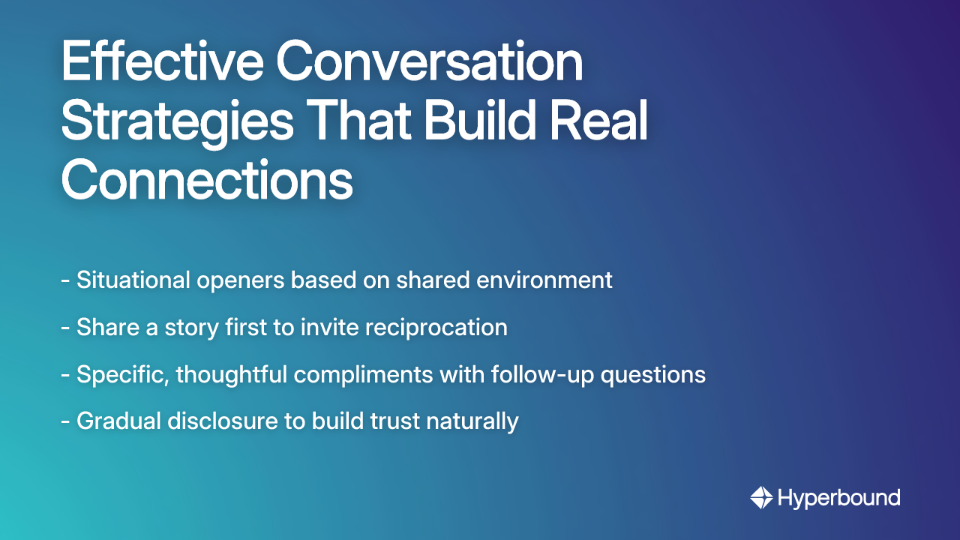
Observe and Comment: The Power of Situational Openers
The most natural way to start a conversation is to comment on your shared environment or context. These situational openers work because they're low-pressure, relevant, and grounded in your shared reality.
Examples:
- "This coffee shop makes the best lattes in town. Do you come here often?"
- "That was an interesting presentation. What did you think about the speaker's point on X?"
Conversation experts agree that these contextual openers feel organic because they acknowledge the immediate shared experience.
Offer, Don't Interrogate: Share an Anecdote to Invite a Story
Instead of firing off questions, try sharing a brief, relevant story or observation first. This takes the pressure off the other person and invites reciprocation without demanding it.
Example: Instead of asking "What do you do for fun?", try: "I just started rock climbing last month—turns out I'm terrified of heights but loving the challenge. Have you tried any new activities lately?"
This approach models the vulnerability and openness you're hoping to receive, making it safer for the other person to reciprocate.
The Genuine Compliment: An Easy Entry Point to Their World
A specific, thoughtful compliment can naturally open a conversation pathway. The key is to make it genuine and to follow it with a related question that invites elaboration.
Example: "That's a fascinating book you're reading—I loved how the author explored memory. What's your take on it so far?"
This isn't just flattery; it's recognizing something about the person and expressing authentic interest.
The Gradual Disclosure Method: Building Trust Step-by-Step
Rather than jumping straight to deep questions, follow the natural escalation pattern of human connection. The classic FORD method (Family, Occupation, Recreation, Dreams) provides a simple framework for gradually increasing conversational depth.
Start with lighter topics and only progress to more personal areas as rapport and mutual trust develop. This approach respects the natural rhythm of relationship building.
The Secret Weapon: Turning Question Lists Inward for Self-Reflection
Here's the counterintuitive insight that many conversation starter lists miss entirely: their greatest value might not be in asking others these questions, but in asking them of yourself.
As one Reddit user brilliantly observed: "This is an EXCELLENT list to get to know yourself, which will give your social skills a boost."
Self-reflection builds self-awareness, which is the foundation of authentic connection. When you understand your own stories, values, and perspectives, you bring more to conversations naturally.
The Self-Reflection Practice That Transforms Your Conversations
- Choose a Quiet Space: Take a list of "conversation starters" and find time for personal reflection.
- Ask Yourself: Use the questions for journaling or contemplation:
- "What are my guiding principles in life?"
- "What makes life meaningful for me?"
- "What's a funny story from my last vacation?"
- Identify Your Stories: From these reflections, develop 3-5 core anecdotes about your passions, challenges, or experiences.
- Refine Your Narrative: Practice telling these stories concisely. This preparation allows you to share meaningful personal insights instead of frantically searching for the perfect question.
For professionals, especially in sales, practicing these narratives in a realistic setting is key. AI-powered tools like Hyperbound allow you to refine your storytelling and objection handling in a safe, simulated environment, ensuring you're prepared for crucial conversations.
When you've done this work, conversations become less about interrogating others and more about authentic exchange. You'll find yourself naturally weaving in your experiences in response to what others share.

Ditch the Script, Build Connections
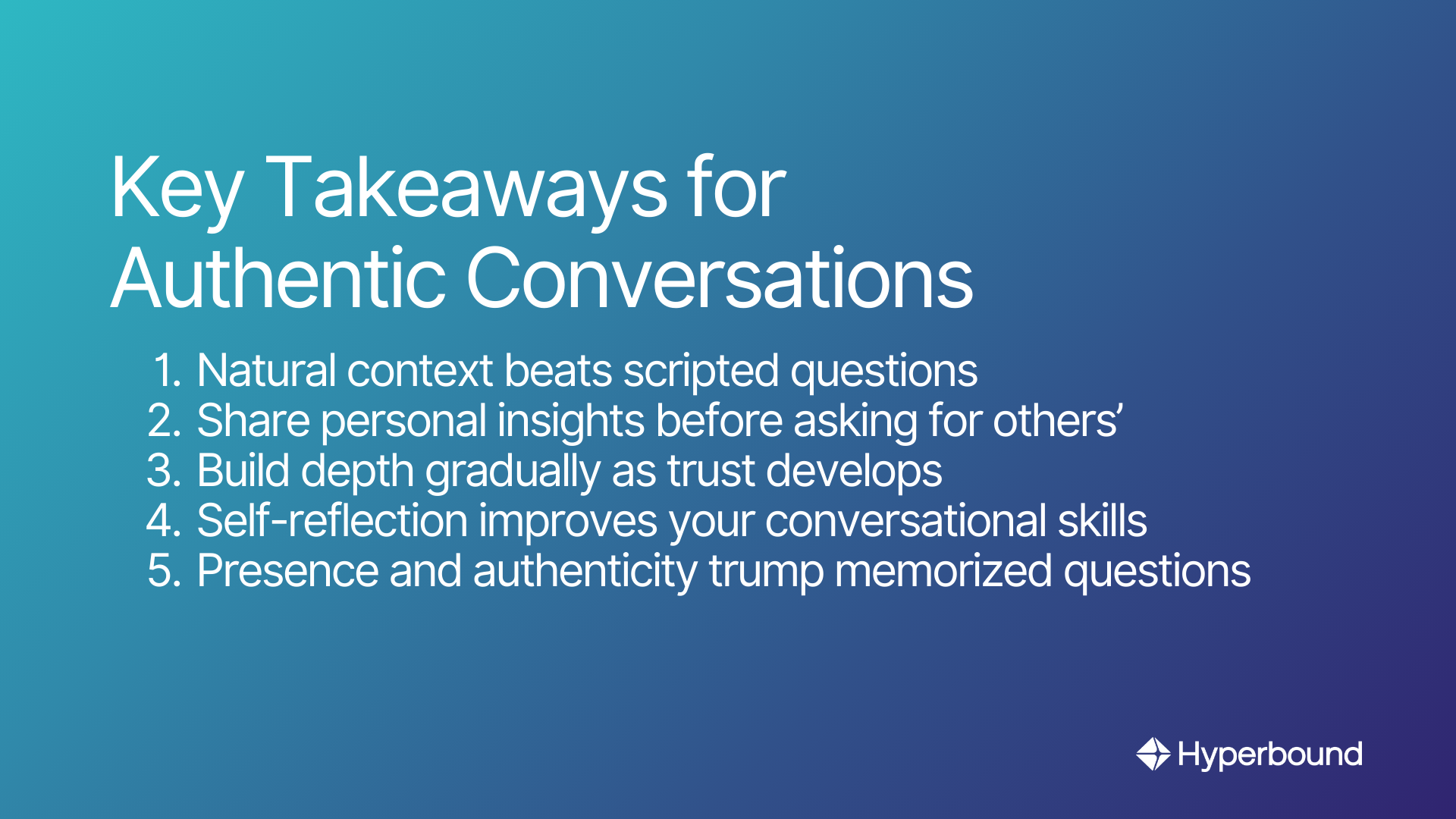
The solution to better conversations isn't finding the perfect list of questions—it's developing a more flexible, authentic approach to human connection.
Stop treating conversations like interviews with strangers. Instead:
- Use contextual observations to start naturally
- Share before you ask
- Build gradually from light to deeper topics
- Develop your own stories through personal reflection
Remember that genuine connection comes from authentic curiosity and presence—not from memorizing the "perfect" questions. The next time you feel that awkward silence looming, resist the urge to pull out a mental checklist of deep questions. Instead, simply notice something real about the moment you're sharing, and start there.
Your best conversations won't come from a list—they'll emerge from being fully present and bringing your authentic self to each interaction.
Frequently Asked Questions
Why do most conversation starter lists fail?
Most conversation starter lists fail because they push for deep, personal information too quickly, creating awkwardness before any trust is established. These lists often contain "therapy session" style questions that demand premature vulnerability or rely on clichés that lead to dead-end conversations, encouraging a rigid script over natural, adaptive dialogue.
What is a better alternative to using conversation starter lists?
A better alternative is to focus on genuine, context-aware interaction by using situational openers, sharing a brief personal anecdote first, and offering a specific compliment. Instead of interrogating someone, observe your shared environment and build from there. This approach prioritizes active listening and gradual connection over a mechanical script.
How can I start a conversation naturally without a script?
The most natural way to start a conversation is with a situational opener—a comment or question based on your shared environment. For example, you could comment on the coffee at a café, an interesting point from a presentation you both attended, or a book someone is reading. These openers feel organic because they are relevant, low-pressure, and grounded in a shared, immediate experience.
When is the right time to ask deeper, more personal questions?
The right time to ask deeper questions is only after you have established a foundation of rapport and mutual trust through lighter conversation. Connection builds gradually. Start with safer topics and pay attention to the other person's cues. As you share and listen, you'll sense when the conversation can naturally progress to more personal subjects without causing discomfort.
What does it mean to use question lists for "self-reflection"?
Using question lists for self-reflection means asking the questions of yourself to better understand your own stories, values, and perspectives. By thinking through these prompts, you develop clearer self-awareness and a collection of personal anecdotes. This makes you a more authentic conversationalist, as you'll have meaningful stories to share naturally instead of needing a script to interrogate others.
How can I avoid awkward silences in a conversation?
You can avoid awkward silences by shifting your focus from asking the perfect question to active listening and authentic sharing. Instead of panicking, listen closely to what the other person is saying and ask follow-up questions about their response. Be prepared to share a relevant story or observation of your own, creating a balanced, give-and-take dynamic that keeps the conversation flowing.
Book a demo with Hyperbound


