.png)


.png)
You've set up your sales cadence perfectly. Your email campaigns are ready to launch. Your CRM is organized with fresh leads. Then a global crisis hits—and suddenly, everything changes. Your carefully crafted value proposition feels tone-deaf, prospects stop responding, and your sales targets seem increasingly unreachable.
This scenario became reality for countless SDRs and AEs during the COVID-19 pandemic, but the lessons apply to any period of uncertainty—whether it's an economic downturn, industry disruption, or regional crisis.
The key to selling during uncertain times isn't to stop selling—it's to fundamentally shift your approach from transactional to relational. As one sales leader put it during the pandemic: "The best thing to do right now is to be there for your clients/prospects. They will remember that once we are out of this situation."
The Mindset Shift: Why Your Approach Must Change
During a crisis, sales professionals typically respond in one of four ways:
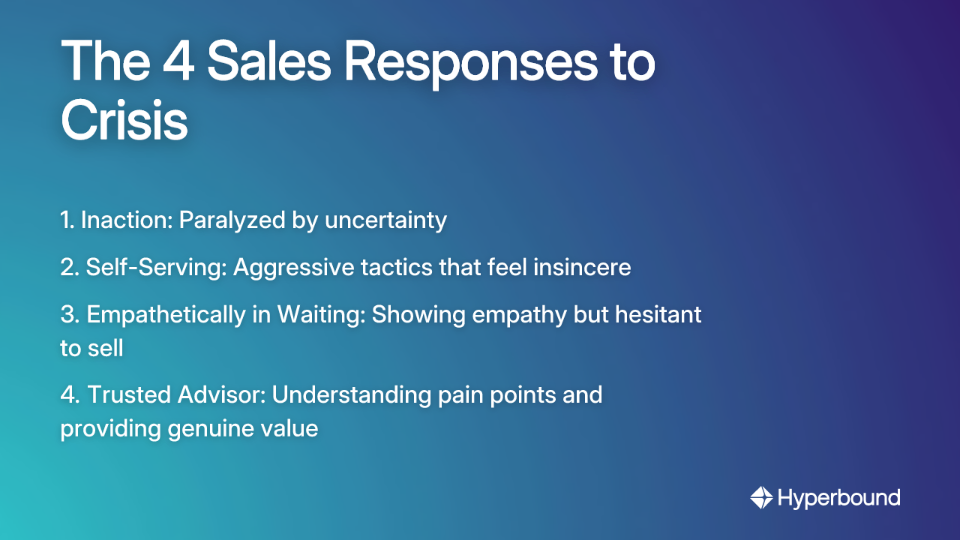
- Inaction: Feeling overwhelmed and paralyzed by uncertainty.
- Self-Serving Behavior: Doubling down on aggressive tactics, appearing insincere.
- Empathetically in Waiting: Showing empathy but hesitating to sell, thereby missing opportunities.
- The Trusted Advisor: Pivoting to understand customer pain points, acting as a resource, and demonstrating genuine care.
According to the 2023 State of Sales report, 87% of business buyers expect sales reps to act as trusted advisors. This expectation only intensifies during uncertain times. A Dale Carnegie survey found that 25% of customers equate trust with a sales rep looking out for their interests—not just pushing for a sale.
Becoming a trusted advisor means shifting from "How can I close this deal?" to "How can I help this prospect navigate their current challenges?" This approach not only preserves relationships but can actually accelerate the sales cycle when the timing is right.

A Practical Playbook for Empathetic Outreach
Strategy 1: Lead with Genuine Empathy, Not a Sales Pitch
During uncertain times, your first priority in any outreach—whether it's cold calling, email campaigns, or social selling—should be to acknowledge the situation and demonstrate understanding.
Here are effective empathy statements you can incorporate into your outreach:
- "If I were in your position, I bet I'd have the same concerns."
- "That sounds incredibly challenging. How are you managing through it?"
- "I understand many [industry] companies are facing [specific challenge]. How is your team handling it?"
- "Before we discuss anything else, I'd like to understand how these changes are affecting your operations."
This approach is particularly important in B2B sales, where buying decisions often involve multiple stakeholders and longer consideration cycles. As one Reddit sales professional noted: "Adjust your pitch to match the current economic conditions and emotional state of your prospects."
A consultative selling approach that begins with understanding the prospect's new reality builds the foundation for a productive conversation.
Strategy 2: Add Value Before You Ask for Anything
In uncertain times, your outreach must lead with value, not requests. This means becoming a resource for your ideal prospect profile, not just another sales rep clogging their inbox.
According to research from Richardson, value-based selling becomes even more critical during economic disruption, as budgets tighten and scrutiny on purchases intensifies. Your ROI calculations need to be concrete, conservative, and crisis-aware.
Here are practical ways to add value through your outreach:
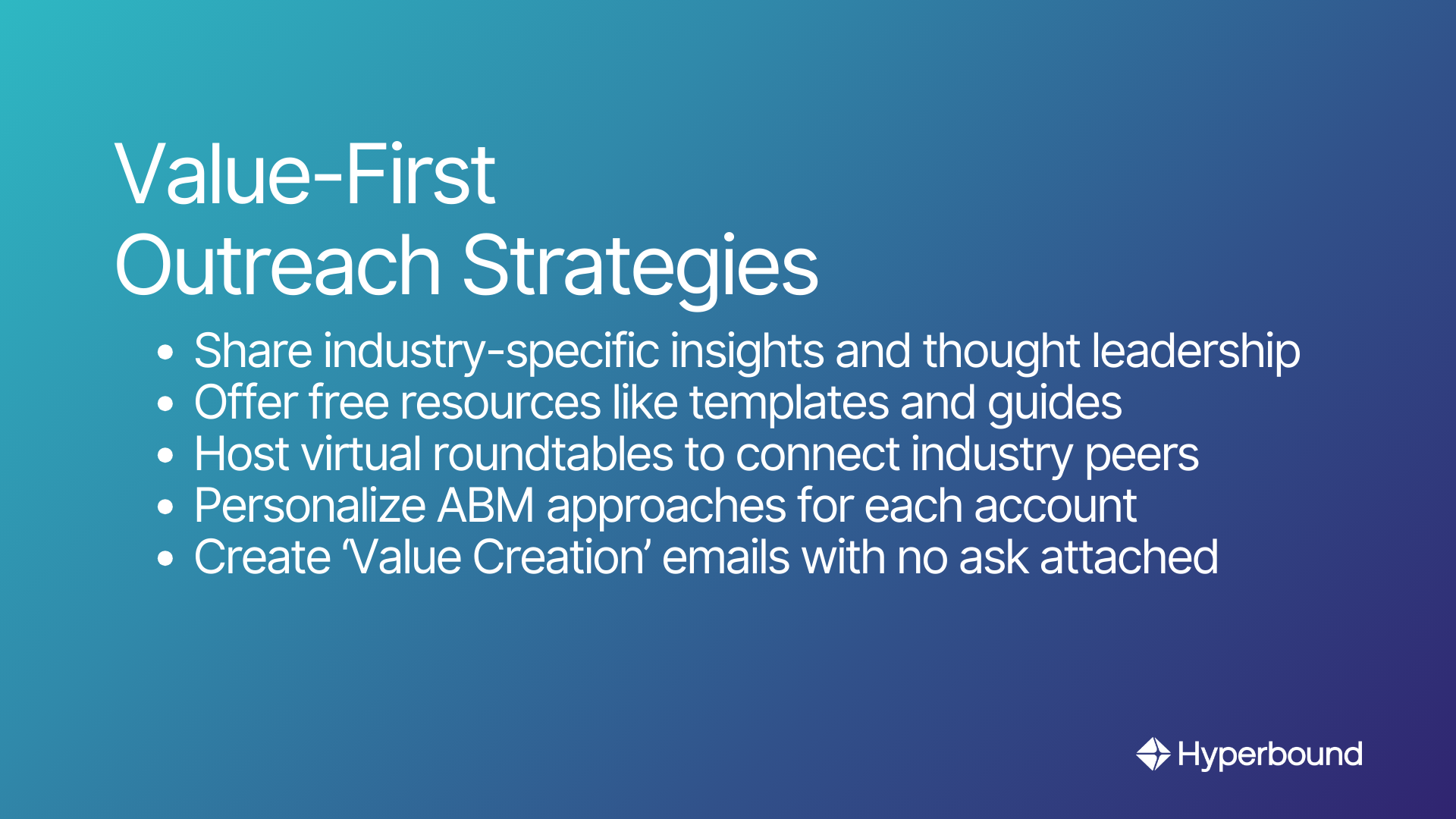
- Share industry-specific insights: Create and distribute thought leadership content that addresses how similar companies are navigating the crisis.
- Offer free resources: Provide templates, checklists, or guides that help prospects address immediate challenges—even if they're not directly related to your solution.
- Host virtual roundtables: Facilitate connections between peers in your prospect's industry, positioning yourself as a connector rather than just a vendor.
- Personalize ABM approaches: Account-Based Marketing becomes even more important during a crisis, as generic messaging falls flat. Research how specific accounts are being impacted and tailor your outreach accordingly.
One effective approach is to create what sales consultant Meridith Elliott Powell calls a "Value Creation" email. This type of outreach shares an insight, article, or resource specifically chosen for the prospect, with no ask attached. It signals that you're invested in their success regardless of whether they buy from you.
A Lead Generation Specialist from a SaaS company shared on Reddit: "In terms of outreach, I mostly focused on providing value through thought leadership pieces. This built credibility that paid off once companies started making purchasing decisions again."
Strategy 3: Adapt Your Cadence and Be Hyper-Relevant
Crisis selling requires a more thoughtful approach to your sales cadence. The frequency, timing, and content of your outreach should reflect the current reality.
Consider these adjustments to your outreach strategy:
Slow down your cadence: During normal times, an SDR might follow up every 2-3 days. In a crisis, extend this to 5-7 days between touches to avoid appearing insensitive.
Time your outreach strategically: Research how different industries are affected by the current crisis. Some may be in survival mode (requiring extreme sensitivity), while others might be experiencing growth (and appreciate solutions that help them scale).
Structure non-aggressive emails: When crafting your outreach, follow this three-step approach shared by an experienced sales professional:
- Ask for time upfront: "I know things are hectic right now, but I was hoping to get 15 minutes of your time next week."
- Provide a short, simple overview: "We're helping companies like X and Y navigate [specific crisis-related problem] by [your solution's benefit]."
- Restate the ask: "Would Tuesday or Thursday afternoon work for a brief call?"
Leverage voicemail effectively: When leaving messages, acknowledge the situation immediately, be brief, and focus on how you've helped similar companies navigate the current challenges.
Most importantly, avoid creating false urgency. As one sales professional warned on Reddit: "Don't drive urgency when there's no good reason to." This damages trust and can permanently harm relationships.
Playing the Long Game: Building a Legacy Beyond the Crisis
The way you sell during a crisis defines your reputation long after the crisis ends. Your actions today become your legacy tomorrow.
Transparency Builds Unshakable Trust
Transparency becomes even more critical during uncertain times. When challenges arise—whether they're related to your product, delivery timelines, or company stability—address them directly.
"When things go wrong, be honest and fix it," advised a sales leader on Reddit. "Follow through, and when there is bad news, don't avoid the call."
This level of transparency might feel uncomfortable in the moment, but it builds the kind of trust that leads to long-term customer relationships and referrals.
Maintain Visibility Without Pressure
During a crisis, many sales professionals make the mistake of disappearing entirely, fearful of appearing opportunistic. However, complete silence can be just as damaging as aggressive selling.
Instead, maintain a consistent, low-pressure presence:
- Schedule regular check-in calls with no sales agenda
- Share relevant resources as they become available
- Celebrate your customers' wins on social media
- Introduce them to helpful connections in your network
These actions demonstrate that you're invested in the relationship beyond the transaction, building the foundation for future business once conditions improve.
Find Opportunity in Crisis
As Jack Ma famously said, "There are always opportunities in a crisis." The biggest opportunity isn't necessarily an immediate sale—it's the chance to demonstrate your character and build unbreakable customer loyalty.
By focusing on relationship-first approaches during difficult times, you position yourself as a partner, not just a vendor. This distinction makes all the difference when budgets free up and buying decisions resume.
Conclusion: Emerge Stronger and More Connected
Crisis selling isn't about new tricks; it's about amplifying the best parts of sales—human connection, problem-solving, and building partnerships. By adopting these strategies, you won't just survive uncertain times; you'll emerge with:
- A stronger pipeline built on genuine relationships
- A reputation as a trusted advisor, not just a salesperson
- A network of advocates who remember how you showed up when it mattered
The SDRs and AEs who thrive during challenging times aren't those with the most aggressive tactics—they're those who demonstrate the most genuine care for their prospects' success.
As you navigate your own outreach during uncertain times, remember that how you sell matters as much as what you sell. By leading with empathy, providing value before asking for anything in return, and playing the long game of relationship building, you'll not only maintain your sales momentum—you'll build a foundation for sustainable success regardless of market conditions.
Frequently Asked Questions
What is the most important mindset shift for selling in a crisis?
The most important mindset shift is moving from a transactional seller to a trusted advisor. This means focusing on how you can genuinely help prospects navigate their current challenges rather than just trying to close a deal. According to sales reports, 87% of buyers expect reps to be trusted advisors, a need that intensifies during uncertainty. This approach builds long-term relationships and trust that pays off when conditions stabilize.
How can I show empathy without sounding insincere?
To show genuine empathy, focus on active listening and asking open-ended questions about your prospect's specific challenges. Avoid generic statements and instead use phrases like, "That sounds incredibly challenging. How is your team managing through it?" or "I understand many companies in your industry are facing [specific challenge]. How is it affecting your operations?" The key is to demonstrate you've done your research and are truly interested in their situation, not just following a script.
Should I stop selling completely during a downturn?
No, you should not stop selling, but you must change your approach. Pausing all outreach can be as damaging as being too aggressive. The key is to shift your focus from hard selling to building relationships and providing value. Maintain a consistent, low-pressure presence by sharing helpful resources, checking in without a sales agenda, and acting as a connector. This keeps you top-of-mind for when they are ready to buy.
What kind of value can I offer if my product doesn't solve an immediate crisis-related need?
You can provide value by becoming a resource hub for your prospects' industry. Share relevant thought leadership, industry reports, or articles that address their current pain points. Offer free resources like templates or checklists. You can also host virtual roundtables to connect peers, positioning yourself as a valuable industry connector rather than just a vendor. This builds credibility and shows you are invested in their success.
How should I adjust my sales cadence during uncertain times?
You should slow down your sales cadence and prioritize relevance over frequency. Instead of following up every 2-3 days, extend the time between touches to 5-7 days to avoid appearing insensitive. Each touchpoint should be hyper-relevant, acknowledging their current situation and offering specific value. Tailor your outreach based on how the prospect's industry is being impacted by the crisis.
What are the biggest mistakes to avoid when selling in a crisis?
The biggest mistakes are using aggressive, self-serving tactics, creating false urgency, and disappearing completely. Pushing for a sale without acknowledging the prospect's reality will damage trust. Similarly, creating artificial deadlines or discounts feels tone-deaf and can permanently harm the relationship. On the other hand, going silent means you miss opportunities to build relationships. The best approach is a balanced one: stay visible, be empathetic, and provide value without pressure.

For an additional resource on adapting your sales approach during uncertain times, check out Meridith Elliott Powell's book Thrive: Strategies to Turn Uncertainty to Competitive Advantage.
Book a demo with Hyperbound


