.png)


.png)
You log into work on Monday morning, and the frustration immediately sets in. You need to prepare for a client call, but the information you need is scattered across Google Docs, your CRM, and random Slack threads. Your company has a "sales enablement platform," but it's essentially just a fancy content dumping ground that solves the storage problem without addressing what you truly need—the right information at the exact moment you need it.
Sound familiar? This fragmentation isn't merely an inconvenience—it's a symptom of a deeper issue: the traditional silo between Sales (the "hunters") and Customer Success (the "farmers"). This disconnect leads to clunky customer handoffs, inconsistent messaging, missed expansion opportunities, and ultimately, revenue leaks.
The good news? AI has emerged as the technological bridge that can finally unify Sales and Customer Success enablement. It transforms enablement from a passive library of content into an active, intelligent coaching engine that drives consistent, high-impact behaviors across the entire customer lifecycle, from the first cold call to the crucial renewal conversation.
The High Cost of Misalignment: Why Your GTM Teams Must Speak the Same Language
The traditional operational silos between Sales and Customer Success create a fragmented customer experience that hurts your bottom line:
- Sales is measured on new logos and acquisition speed
- Customer Success is measured on retention, satisfaction (NPS/CSAT), and net revenue retention (NRR)
This creates different playbooks, different priorities, and a disjointed experience for customers who only see one company. The consequences are tangible and costly:
.png)
- Poor Handoffs: Critical context gathered during the sales process is lost, forcing customers to repeat themselves to the CS team.
- Inconsistent Value Proposition: The value promised by Sales may not align with the value delivered and reinforced by CS, leading to unmet expectations.
- Missed Expansion Revenue: Sales has little visibility into post-sale customer health, while CS may lack the commercial instincts or training to effectively identify and act on upsell/cross-sell opportunities.
Building a customer-centric culture, where all teams contribute to customer outcomes, is essential for sustainable revenue growth. But how do you actually make this happen?
The Foundation: Core Strategies for Unifying Sales and CS
Before diving into AI tools, it's important to establish core process and cultural frameworks for alignment. AI technology enhances these strategies; it doesn't replace them.
Strategy 1: Create Joint Account Plans
Establish a single, collaborative document that serves as the hub for all teams (Sales, CS, Marketing). According to Totango, a comprehensive account plan should include:
- Business goals and clear value plans
- Key stakeholders and their priorities
- Risks and expansion opportunities identified early
The benefit? Faster deal cycles and proactive renewal discussions.
Strategy 2: Define Clear Roles with a RACI Model
Clearly document who is Responsible, Accountable, Consulted, and Informed at each stage of the customer journey, especially at the critical handoff point. This eliminates ambiguity and establishes clear ownership.
Strategy 3: Implement a Regular Accountability Cadence
Hold bi-weekly account plan reviews with both Sales and CS stakeholders to assess progress, risks, and opportunities. Unify go-to-market functions around common objectives in a recurring revenue team meeting.
AI as the Great Enabler: Technology to Bridge the Gap
While the strategies above create a solid foundation, AI is the engine that makes them scalable, data-driven, and effective. Consider this: 63% of teams using AI in enablement report a higher revenue impact than those that don't, according to Seismic research.
Here's how AI transforms alignment between Sales and CS:
Creating a Single, Data-Backed Playbook
Problem: Sales and CS often work from different playbooks based on anecdotal evidence.
AI Solution: AI conversation intelligence can analyze thousands of real customer conversations—from both top-performing AEs and CSMs—to codify what winning behaviors, talk tracks, and objection-handling techniques actually work.
Platforms like Hyperbound use AI to Analyze Winning Behaviors, creating a unified, data-driven playbook for the entire customer lifecycle, rather than relying on separate, outdated documents. This ensures consistent messaging and approaches from first touch to renewal.
Enabling Consistent Execution at Scale
Problem: A playbook is useless if reps and CSMs can't execute it consistently under pressure. Sales reps only spend 28% of their time actively selling, according to Salesforce data, so practice and reinforcement must be hyper-efficient.
AI Solution for Sales: AI provides a safe space to practice and master the playbook.
With AI Sales Roleplays, new AEs and SDRs can practice high-stakes scenarios like discovery calls and pricing objections against a dynamic AI buyer persona. They receive instant, objective feedback from AI-Powered Scorecards, dramatically reducing ramp time.
AI Solution for Customer Success: The same technology applies to post-sales motions.
AI Post-Sales Roleplays allow CSMs to practice navigating difficult renewal conversations, handling customer complaints, or positioning an upsell. This prepares them for the critical conversations that directly impact churn and NRR.
Driving a Data-Driven Accountability Cadence
Problem: Manager call reviews are subjective, time-consuming, and difficult to scale, making the "accountability cadence" inconsistent.
AI Solution: AI automates call analysis and provides objective, consistent scoring for every customer interaction.
Tools like Hyperbound's AI Real Call Scoring can automatically QA calls from both Sales and CS teams against the same unified methodology. Managers get AI-generated summaries and scores, allowing them to focus coaching time on strategy instead of manual review. This provides objective data for joint account reviews, ensuring everyone is aligned to the same standard of excellence.
Your 5-Step Framework for Implementing AI-Powered Enablement
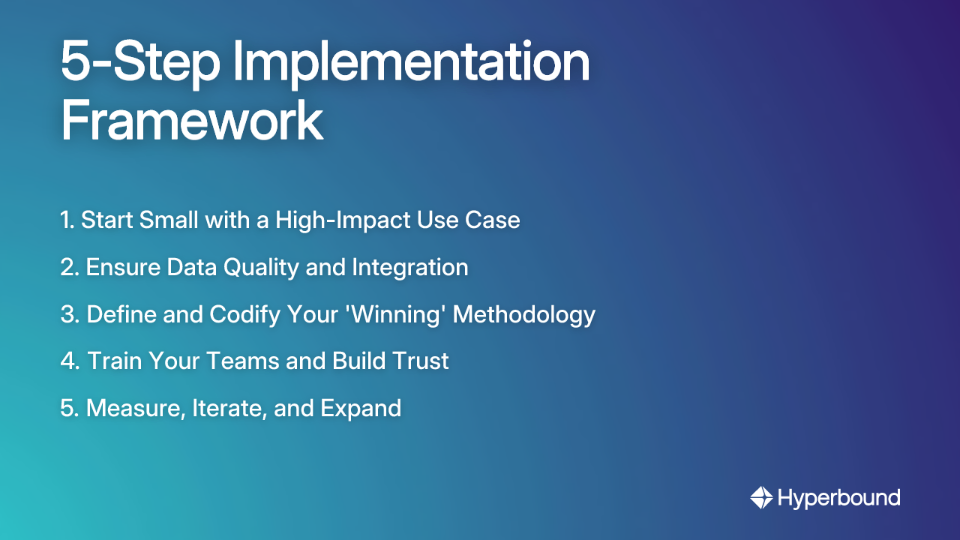
Ready to get started? Here's a clear, actionable roadmap to follow:
Step 1: Start Small with a High-Impact Use Case
Don't try to transform everything at once. Focus on a specific, painful area, such as onboarding new SDRs, improving CSM renewal rates, or rolling out new product messaging. According to Seismic, starting with a focused use case increases adoption and demonstrates value quickly.
Step 2: Ensure Data Quality and Integration
AI's effectiveness depends on the quality of your data. Ensure your platform can integrate with existing call recording systems (like popular call recording and sales engagement platforms) and your CRM to pull in conversation data. As ChurnZero points out, continuous access to customer data allows AI agents to provide timely insights for proactive decision-making.
Step 3: Define and Codify Your "Winning" Methodology
Work cross-functionally with top Sales and CS performers to define the key behaviors, talk tracks, and moments that matter. This collaborative approach ensures buy-in from both teams and creates a methodology that works across the entire customer lifecycle.
Step 4: Train Your Teams and Build Trust
Address change management head-on. Position AI as a personal coach that helps reps and CSMs improve and earn more, not as a surveillance tool. Share success stories and use gamification features like leaderboards to drive adoption. The key is creating a culture where AI is seen as an enabler, not a threat.
Step 5: Measure, Iterate, and Expand
Track key metrics like time-to-first-deal for new hires, call-to-meeting conversion rates, and net revenue retention. Use the AI analytics to identify skill gaps and refine your playbook.
Once you prove the value, expand to other use cases. For example, use AI Roleplay Hiring Assessments to screen sales candidates for practical skills, ensuring you hire people who can execute your playbook from day one.
From Silos to Synergy: The Future of Revenue Teams
True alignment between Sales and Customer Success is no longer a "nice-to-have." In a competitive market, it's a requirement for efficient growth.
AI provides the missing link, transforming enablement from a static content repository into a dynamic, personalized coaching system. By leveraging AI to define, practice, and measure a unified playbook, you can finally break down the silos and ensure every person on your go-to-market team is equipped to deliver a world-class customer experience—from acquisition to advocacy.
The companies that thrive in the coming years will be those that recognize the power of unified revenue teams and leverage AI to make that vision a reality. The technology exists today—are you ready to put it to work?
Frequently Asked Questions
What is AI-powered enablement?
AI-powered enablement is a system that uses artificial intelligence to actively coach and improve the performance of go-to-market teams, transforming traditional content libraries into intelligent, data-driven training platforms. Unlike passive content repositories, AI systems analyze real customer conversations to identify what works, allow teams to practice winning behaviors in simulated scenarios, and provide objective feedback at scale, creating a continuous loop of improvement.
Why is aligning Sales and Customer Success so critical for business growth?
Aligning Sales and Customer Success is critical because it creates a seamless customer experience that directly impacts revenue through improved retention, reduced churn, and increased expansion opportunities. When these teams operate in silos, it leads to poor customer handoffs and inconsistent messaging. A unified approach ensures the promises made during the sales process are delivered upon, leading to higher customer satisfaction and increased Net Revenue Retention (NRR).
How does AI help unify Sales and CS teams?
AI helps unify Sales and CS teams by creating a single, data-driven playbook based on the analysis of thousands of real customer conversations from both departments. AI conversation intelligence identifies the talk tracks and behaviors of top performers across the entire customer lifecycle. This insight is then used to build a unified methodology and scale it through AI-powered practice and coaching, ensuring everyone is aligned on what "good" looks like.
Can AI replace sales managers or enablement teams?
No, AI does not replace managers or enablement teams; it enhances their capabilities by automating time-consuming tasks and providing objective data. AI tools handle the manual work of reviewing calls and providing first-level feedback, freeing up managers to focus on high-level strategy and personalized coaching. It acts as a co-pilot, not a replacement.
What is the first step to implementing AI for sales and CS enablement?
The best first step is to start small with a single, high-impact use case where you can quickly demonstrate value. Instead of attempting a full-scale transformation, focus on a specific pain point, such as improving the onboarding process for new SDRs or increasing renewal rates for CSMs. Proving the ROI in a focused area builds momentum and buy-in for broader adoption.
How does AI improve the customer handoff from Sales to Customer Success?
AI improves the customer handoff by ensuring both teams are trained on a unified playbook and understand the key context and commitments made during the sales process. By analyzing sales calls, AI can surface critical information for the CS team. Furthermore, by training both AEs and CSMs on the same value propositions, AI ensures the conversation feels consistent from the customer's perspective, setting the stage for a successful long-term partnership.

Book a demo with Hyperbound


