.png)


.png)
"You don't seem like the type who can afford this model. Maybe we should look at something in your price range."
"If you don't buy today, I can't guarantee this price tomorrow."
"What would it take for you to drive this home today? I mean, what do I need to do to earn your business RIGHT NOW?"
If you've ever shopped for a car, these cringe-worthy lines might sound painfully familiar. Even worse, someone may have accused you of "not being a man for buying a Tremor over a Raptor" or suggested you're "too poor to afford the car" in a misguided attempt to trigger your pride into making a purchase.
These pushy sales tactics aren't random accidents. They're calculated techniques still being actively taught in sales training programs across America, particularly in automotive dealerships. And they're turning customers away in droves.
As one frustrated customer put it in a recent Reddit thread, "Pushy sales tactics def are a turnoff and make people feel uncomfortable and that they can't trust you!" Another observed, "The 80s is over, but whatever sales manager 'trained' the guys you ran into is still living in the 80s."
This raises a troubling question: Why, in an age of informed consumers, digital transparency, and relationship-focused commerce, are sales organizations still teaching manipulative tactics from the Reagan era?
This investigative piece dives deep into the persistent disconnect between how companies train salespeople and what modern consumers actually respond to. We'll examine why these outdated methodologies stubbornly linger, particularly in the automotive industry, which one sales professional bluntly described as "the sales basement." Finally, we'll explore how progressive organizations are breaking the cycle with training that aligns with today's buyer expectations.
The Ghosts of Sales Past: Identifying 1980s Tactics in a 2024 World
Before we can understand why these antiquated methods persist, we need to recognize what they look like. The high-pressure sales techniques popular in the 1980s weren't about persuasion in the true sense—they were about manipulation and control.
High-Pressure Methods That Never Died
The foundation of old-school sales training rests on creating artificial urgency, steamrolling objections, and controlling the entire conversation. These approaches aren't designed to help customers make good decisions—they're designed to push them into making any decision, preferably right now.
Anthony Iannarino, founder of The Sales Blog, explains that many of these techniques are still actively taught today: "These outdated methods stem from a fear of losing rather than a strategy for success. They're a crutch for those who lack the ability to sell effectively based on value."
Common tactics include:
.png)
- Artificial Urgency: "This deal ends today" or "Someone else is looking at this same model"—statements designed to rush decisions by manufacturing scarcity.
- Tie-Downs: A manipulative questioning technique where salespeople corner clients into a series of "yes" responses, making it harder to say "no" later. "You want something reliable, don't you?" "You'd like to save money on gas, right?"
- Ego-Based Attacks: Comments designed to trigger insecurity or pride, like suggesting a customer is too poor to afford a particular model or questioning their masculinity for choosing a certain vehicle.
- The Assumptive Close: Acting as if the sale is already complete when it isn't, such as starting paperwork without explicit agreement or asking, "Would you prefer delivery on Thursday or Friday?" before the customer has committed to buying.
- The False Comparison: Presenting an artificially inflated initial price so the "discounted" price seems like a bargain, even when it's not.
These methods can occasionally work, particularly with customers uncomfortable with conflict. But they come at an enormous cost: destroyed trust. And in today's connected world, that damage extends far beyond a single lost sale.
The High Cost of Outdated Tactics
When salespeople employ these aggressive tactics, they're not just risking a single transaction—they're reinforcing negative stereotypes about the entire profession.
"This is why salesmen get bad raps," noted one commenter in an online discussion about high-pressure tactics. The reputational damage creates a vicious cycle: consumers enter sales interactions with their guards up, making it harder for even honest salespeople to build genuine connections.
The financial impact is equally devastating. According to research from Fullpath, pushy sales tactics are directly linked to:
- Lower customer satisfaction scores
- Reduced repeat business (down 25-40% compared to consultative approaches)
- Fewer referrals (a critical source of high-quality leads)
- Increased negative online reviews (each one potentially influencing dozens of future customers)
So if these methods are so destructive, why do they persist in training programs? The answer reveals deep structural problems in how sales organizations develop their people.
The Training Disconnect: Why Are We Still Teaching This?
The persistence of outdated sales tactics isn't random—it's systematic. Several interconnected factors create a perfect storm that keeps 1980s methodologies alive in training programs despite their poor results.
Inertia at the Top: The "It Worked For Me" Problem
Many sales leaders rose through the ranks during the heyday of high-pressure selling. They succeeded using these tactics in their early careers, creating a powerful cognitive bias that what worked for them should work for everyone.
"Sales managers are often promoted based on their individual success, not their ability to train others," explains Ryan Estis, sales leadership consultant and author. "They teach what they know—and what they know came from a different era of selling."
This creates a generational echo chamber where outdated methods are passed down like family recipes, regardless of whether they still taste good to modern palates.
The Vicious Cycle of High Turnover
Perhaps nowhere is this problem more evident than in automotive dealerships, where employee churn is epidemic. According to research from getrapl.com, over 30% of dealership employees leave within just 9 months due to low job satisfaction and inadequate training.
This turnover creates a constant need for quick, cheap onboarding, which often defaults to easily replicated scripts and pressure tactics instead of developing deeper consultative skills.
"When you're constantly replacing staff, you don't invest in quality training," says Jason Volny, former dealership sales manager turned training consultant. "You need bodies on the floor immediately, so you teach them the minimum—usually aggressive closing techniques that require little skill but produce occasional short-term results."
This creates a self-perpetuating cycle: poor training leads to pushy salespeople, who create unhappy customers and a toxic work environment, which increases turnover, necessitating more quick-and-dirty training.
The Failure of Traditional Training Models
Even when organizations do invest in training, the delivery model often dooms it to failure. According to one leading sales training organization, 70% of sales training fails to achieve any measurable ROI.
Why? Because most training is delivered as one-off motivational events rather than ongoing skill development processes.
"A sales road show with a charismatic speaker can create temporary excitement," notes Jason Forrest, a sales training CEO. "But without consistent reinforcement and accountability, salespeople quickly revert to old habits—especially when those old habits are being reinforced by immediate managers."
The training industry itself bears some responsibility. Many programs still emphasize closing techniques over needs assessment and relationship building because they're easier to teach in a one-day seminar and provide the illusion of immediate results.

Pressure-Cooker Metrics Drive Bad Behavior
Perhaps most insidiously, the metrics used to evaluate salespeople often incentivize exactly the wrong behaviors. When compensation and job security are tied exclusively to short-term results, ethical corners get cut.
"Every month, on-site inventory dings their monthly profit picture," explained one automotive industry insider on Reddit. This pressure to move inventory creates a desperate environment where any tactic that might close a deal becomes acceptable, even if it permanently alienates the customer.
Salespeople aren't stupid—they respond to how they're measured. When the only metric that matters is this month's closed deals, the long-term damage of high-pressure tactics becomes someone else's problem.
Case Study: The Automotive "Sales Basement"
Nowhere are these problems more evident than in automotive retail—an industry one sales professional colorfully described as "the sales basement." Car dealerships have become the poster child for pushy tactics and outdated training methods, creating a perfect case study of how these issues manifest in practice.
Why Auto Sales Is a Perfect Storm for Bad Practices
Several unique factors make automotive retail particularly vulnerable to outdated sales approaches:
1. The Information Asymmetry Has Flipped
Traditionally, car salespeople had an enormous knowledge advantage over customers. They knew invoice prices, profit margins, and inventory levels that customers couldn't access. This information asymmetry made high-pressure tactics effective—customers had no way to verify claims about "special, one-time offers."
Today, that advantage has evaporated. According to Fullpath, 95% of car buyers research online before ever stepping into a dealership. They arrive armed with invoice prices, competitor offers, and third-party valuations of their trade-ins.
Yet many dealerships still train as if it's 1985, creating an immediate credibility gap when salespeople try to control information that customers already have.
2. Complex Profit Structures Create Perverse Incentives
Car sales involve multiple profit centers—the vehicle margin, financing, extended warranties, trade-ins, and accessories. This complexity creates strong incentives to push customers toward the most profitable options rather than the best solutions for their needs.
"If you eliminate all the profit generating options (including trade-ins, accessories, and financing), all that's left is whether or not the dealership is carrying too much inventory on that particular model," explained an industry insider in an online forum.
This focus on "profit generating options" often drives aggressive upselling tactics that prioritize the dealership's bottom line over customer satisfaction.
3. Geographical Dispersal Leads to Training Inconsistencies
Large automotive companies with dealerships spread across vast regions suffer from major inconsistencies in training quality and brand messaging. According to getrapl.com, this geographic dispersal makes it difficult to implement consistent, high-quality training programs.
The result is a patchwork of approaches, often defaulting to whatever the local sales manager learned decades ago rather than a cohesive, modern sales philosophy.
The Disconnect in Action
The gap between customer expectations and salesperson behavior in automotive retail is stark. As one frustrated observer put it: "I have never understood why people are so bad at the basics: say hello, understand quick needs and see if there's will and possibility to close fast."
This disconnect manifests in several common scenarios:
- A customer enters with specific research about a vehicle but faces a salesperson who ignores this preparation and tries to redirect them to a different (more profitable) model.
- A buyer indicates they're in the early stages of shopping but gets hammered with closing techniques designed to force an immediate decision.
- Someone exploring options encounters "cringey BS tactics" like questioning their judgment, financial capability, or even masculinity instead of helpful information.
Each of these interactions reinforces negative perceptions about car shopping and pushes buyers toward online alternatives that bypass the traditional dealership model entirely.
The Modern Sales Playbook: A Blueprint for Building Trust and Driving Results
The good news is that a growing movement of progressive sales organizations is breaking the cycle of outdated training. They're proving that better approaches not only improve customer satisfaction but also drive superior financial results.
The Foundational Shift: From Pressure to Partnership
Modern sales success isn't about manipulation—it's about creating value through trust. This represents a fundamental shift from a transactional mindset to a consultative role focused on helping clients make informed decisions that align with their needs.
"The buyer's journey has changed dramatically, but many sales training programs haven't kept pace," explains Anthony Iannarino of The Sales Blog. "Today's successful approach centers on building trust first and selling second."
Core Pillars of Modern Sales Training
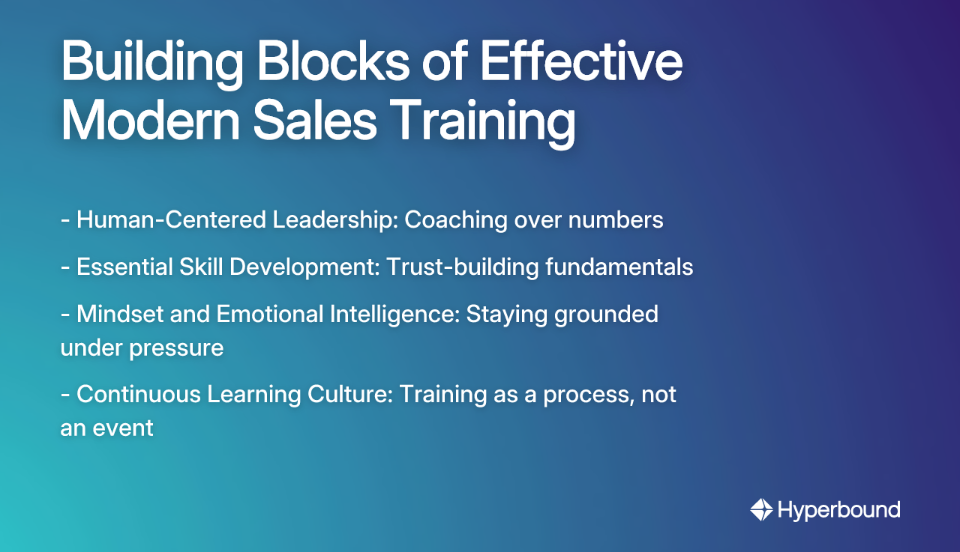
Forward-thinking organizations are rebuilding their training programs around several key principles:
1. Human-Centered Leadership
Great sales leaders prioritize coaching and development over short-term numbers. According to research from Ryan Estis, companies with strong coaching cultures report 21% stronger business results and 29% higher employee engagement.
These leaders model the behavior they want to see, focusing on:
- Regular one-on-one coaching sessions
- Celebrating ethical wins, not just revenue
- Creating psychological safety for skill development
- Building team collaboration instead of cutthroat competition
2. Essential Skill Development
Modern training focuses on developing fundamental skills that build trust rather than tricks to manipulate buyers:
Active Listening: Training reps to identify unstated needs and ask powerful questions that guide buyers to their own conclusions. This includes techniques for reading body language, recognizing emotional signals, and responding empathetically.
Objection Handling: Teaching salespeople to welcome objections as opportunities for dialogue rather than obstacles to overcome. Modern approaches frame objections as requests for more information or clarification rather than rejection.
Value Selling: Shifting focus from features to business impacts and outcomes. This requires salespeople to deeply understand their offerings and connect them directly to customer priorities.
3. Mindset and Emotional Intelligence
High-performing sellers stay grounded under pressure and manage their emotional responses effectively. Modern training incorporates techniques for:
- Managing rejection constructively
- Maintaining composure in difficult conversations
- Recognizing and regulating emotional triggers
- Building genuine empathy for customer challenges
4. Continuous Learning Culture
Perhaps most importantly, effective organizations recognize that training isn't an event—it's a process. Companies with dynamic, continuous training programs report up to 28% higher win rates according to CSO Insights.
This means creating systems for:
- Regular skill reinforcement
- Peer learning and knowledge sharing
- Just-in-time microlearning
- Measuring and improving specific behaviors
This is where modern tools like AI coaching platforms make a significant impact. Platforms such as Hyperbound allow teams to scale best practices through AI-powered roleplays and provide objective, data-driven feedback on both practice and real calls, creating a true continuous learning loop.
How Progressive Dealerships Are Winning the Future of Sales
Some forward-thinking automotive retailers are already implementing these principles, with impressive results. Their approaches include:
Embracing Technology for Personalization
Progressive dealerships are leveraging technology to create personalized experiences that build trust from the first interaction:
Customer Data Platforms (CDP): Leading retailers use CDPs to create a 360-degree view of customers. When a buyer walks in, sales consultants can greet them by name and reference their online activity, creating a seamless experience that acknowledges the research they've already done. Fullpath notes this approach can increase conversion rates by up to 20%.
Artificial Intelligence (AI): Forward-thinking dealerships employ AI to identify high-intent shoppers, automate personalized follow-ups, and power 24/7 engagement with chatbots on their websites. According to Fullpath, these tools can increase qualified lead generation by 35% while reducing the need for pushy follow-up calls.
Revolutionizing the Training Program
Innovative dealerships are completely reimagining how they prepare salespeople for success:
Custom, Tactical Training: Rather than generic motivational sessions, they implement specific, tactical "how-to" training tailored to their unique selling environment. Top-ranked sales training programs, for example, focus on practical application rather than abstract theory.
Ongoing Reinforcement: They implement accountability structures like weekly coaching sessions and monthly skill development for both new and experienced team members. This consistent reinforcement helps overcome the Ebbinghaus Forgetting Curve, where 70% of training content is typically forgotten within 24 hours without reinforcement.
Digital Solutions for Modern Problems: Progressive dealerships use AI-powered training platforms to make learning engaging, consistent, and scalable. For example, platforms like Hyperbound allow sales reps to practice any scenario—from handling tough objections to introducing new models—with hyper-realistic AI buyers. This provides a safe, repeatable environment to master modern talk tracks and builds confidence before they ever speak to a real customer.
The ROI of Modern Training
The investment in better training approaches shows clear returns:
Productivity: Research published in ResearchGate demonstrates that effective training leads to 37% higher productivity among retail employees.
Retention: Well-trained employees are 69% more likely to stay with a company for three years or more, according to getrapl.com. This breaks the costly cycle of turnover that plagues traditional dealerships.
Customer Satisfaction: Dealerships that have adopted modern, trust-based selling approaches report Net Promoter Scores 40-60 points higher than industry averages, translating directly into referrals and repeat business.
Conclusion: Escaping the Sales Basement
The persistence of 1980s sales tactics in modern training programs isn't evidence of their effectiveness—it's a symptom of organizational failure to adapt to changing consumer expectations. As one customer aptly put it, "The 80s is over, but whatever sales manager 'trained' the guys you ran into is still living in the 80s."
This failure comes at an enormous cost: alienated customers, high employee turnover, damaged brand reputations, and ultimately, lost revenue and market share. In industries like automotive retail, these outdated approaches have created "sales basement" environments that drive consumers toward alternative purchasing channels.
The path forward requires a fundamental shift from pressure to partnership. Organizations that succeed in this transition focus on:
- Building trust through transparency rather than controlling information
- Developing consultative skills instead of manipulative techniques
- Establishing continuous learning cultures that reinforce ethical, customer-centered behaviors
- Leveraging technology to personalize experiences, not just automate old processes
- Measuring long-term success metrics beyond this month's closed deals
For sales leaders, the choice is clear: remain in the "sales basement" with outdated, "cringey BS tactics" that alienate modern consumers, or build a sales organization that respects customers, empowers salespeople, and drives sustainable growth.
As high-pressure tactics become increasingly ineffective with informed consumers, the organizations that thrive will be those that invest in training programs aligned with contemporary buying behaviors—focusing on needs assessment, solution-based selling, and authentic customer engagement.
The future of sales belongs to those who recognize that the art of persuasion isn't about manipulation—it's about creating so much value that the purchase decision becomes the obvious next step in a relationship built on trust.
Frequently Asked Questions
What are some examples of outdated, high-pressure sales tactics?
Outdated, high-pressure sales tactics include creating artificial urgency, using manipulative questions (tie-downs), making ego-based attacks, acting as if the sale is already complete (the assumptive close), and presenting false price comparisons. These methods, popular in the 1980s, are designed to control and manipulate customers rather than help them. For example, a salesperson might say "This offer is only good for today" to create false scarcity or ask a series of leading questions like "You want a safe car, don't you?" to make it difficult for a customer to say no later on.
Why do companies still teach these pushy sales methods?
Companies still teach pushy sales methods due to a combination of leadership inertia ("it worked for me"), high employee turnover that encourages quick and cheap training, and performance metrics that prioritize short-term results over long-term customer relationships. In industries like automotive sales, high churn rates lead to a reliance on easily replicated, aggressive scripts. Furthermore, when salespeople are measured only on monthly quotas, they are incentivized to use any tactic that might close a deal, regardless of the damage to customer trust.
How do modern sales approaches differ from old-school tactics?
Modern sales approaches focus on building trust and partnership, while old-school tactics rely on pressure and manipulation. A modern salesperson acts as a consultant or advisor, using skills like active listening and value selling to help customers make informed decisions. Instead of steamrolling objections, they treat them as opportunities for dialogue. The goal shifts from closing a single transaction to creating a long-term relationship built on value and transparency.
What is the real cost of using outdated sales tactics for a business?
The real cost of using outdated sales tactics includes lower customer satisfaction, reduced repeat business and referrals, an increase in negative online reviews, and damage to the company's overall brand reputation. While a pushy tactic might secure a single sale, it destroys trust. This leads to significant financial consequences, such as a 25-40% reduction in repeat business compared to consultative approaches and makes it harder for all salespeople to build rapport with new, skeptical customers.
How can a salesperson transition from pushy tactics to a modern, consultative approach?
A salesperson can transition to a modern approach by focusing on developing core skills like active listening, handling objections constructively, and value selling, all supported by a culture of continuous learning and coaching. This involves shifting one's mindset from "closing a sale" to "solving a problem." Practicing these skills in safe environments, such as through AI-powered roleplays, can build the confidence needed to apply them in real-world customer interactions.
What role does technology like AI play in modern sales training?
Technology, particularly AI, plays a crucial role in modern sales training by providing scalable, consistent, and personalized practice environments for salespeople. AI coaching platforms allow sales reps to practice handling any customer scenario with a realistic AI buyer, creating a safe space to master modern techniques without risking real customer relationships. AI also provides objective, data-driven feedback, helping to create a continuous learning loop that traditional one-off training events cannot match.
Have you encountered outdated sales tactics in your shopping experiences? What approaches do you find most effective as a consumer or sales professional? Share your experiences in the comments below.

Book a demo with Hyperbound


