.png)


.png)
Summary
- Effective negotiation hinges on the "give to get" principle: never make a concession without receiving something valuable in return, such as a longer contract or referral.
- Prepare for every negotiation by defining your ideal outcome, acceptable terms, and absolute walkaway point (BATNA) to avoid giving excessive discounts.
- Master high-stakes conversations by practicing key skills like active listening to uncover true needs, quantifying your value to defend pricing, and analyzing past deals for lessons learned.
- Build your team's confidence and muscle memory with AI Sales Roleplays, allowing reps to practice tough negotiation scenarios in a risk-free environment.
You're in the final stretch of closing a major deal when suddenly the prospect says, "Your price is too high compared to your competitors. We need a 20% discount to move forward." Your heart sinks as you see your commission shrinking before your eyes. Should you give the discount to save the deal? Negotiate via email? Or hold firm and risk losing everything?
If this scenario makes you anxious, you're not alone. Many sales professionals struggle with negotiation, often giving concessions without getting anything in return or feeling like a "sketchy car salesman" when trying to defend their pricing.
.png)
Effective negotiation isn't about aggressive tactics or manipulation. It's about creating mutually beneficial outcomes where both parties walk away satisfied. When done right, negotiation protects your margins, strengthens client relationships, and turns customers into advocates for your business.
The cornerstone of successful negotiation is the "give to get" principle—never make concessions without receiving something valuable in return. As one experienced sales professional put it: "The bigger the ask, the larger the counter."
Instead of more theory, this article provides eight practical, repeatable exercises that build the muscle memory needed to navigate any negotiation scenario. These drills will help you transform from a discount-giver to a value-demonstrating, deal-closing professional.
Exercise 1: Master High-Stakes Scenarios with AI-Powered Role-Play
Nothing prepares you for real-world pressure better than simulated practice. Role-playing builds confidence and adaptability, but scaling it is a classic challenge. Modern tools like Hyperbound's AI Sales Roleplays allow reps to practice critical conversations against realistic AI buyer personas, providing a safe and repeatable environment to master negotiations before facing actual customers.

How to Practice:
- Set up the "Role-Play Champions" game:
- Form teams of three: one salesperson, one prospect, and one observer
- Create scenario cards with common negotiation challenges
- After each round, the observer provides structured feedback
- Practice these critical scenarios:
- The Price Haggler:
- Prospect: "Your competitor is offering me a 25% discount. Can you match that?"
- Bad Response: "Let me see what I can do." (This immediately signals willingness to discount without getting anything in return)
- Good Response: "That's a significant discount. Let's first ensure we're comparing apples to apples in terms of value and service. While I may not be able to match that exact number, let's explore a package that fits your budget without compromising the quality and support that sets us apart."
- Advanced Tactic: Use the "Compared to what?" question to understand the basis of their price sensitivity.
- The Sudden Change in Decision-Maker:
- Prospect: "This all looks great, but I need my boss's approval to proceed."
- Good Response: "I understand completely. To make the process smoother for your boss, let's arrange a brief call where I can walk them through the key value points and answer any specific questions they might have. When are they available?"
- This strategy helps avoid the dreaded "game of telephone" that can kill deals.
- The Last-Minute Objection:
- Prospect: "I just heard your competitor has a new feature. Can you match that?"
- Good Response: "That's an interesting development. Let's quickly review the unique outcomes our solution provides for your specific challenges, and then I can get you more information on how our roadmap compares."
- The Price Haggler:
Exercise 2: Become a "Sales Sleuth" Through Active Listening Games
Effective negotiation starts with understanding your prospect's true needs, which are often hidden beneath surface-level requests. Active listening uncovers these deeper motivations, helping you craft solutions that address real pain points.
How to Practice:
- Play the "Sales Sleuth" game:
- Pair up with another rep. One plays the salesperson, the other the prospect.
- The salesperson has 10 minutes to uncover as much information as possible using only questions. No pitching allowed.
- The rep who gathers the most detailed information about challenges, goals, and decision criteria wins.
- Incorporate these techniques:
- Summarize and Reflect: After the prospect speaks, paraphrase their points back to them. "So, if I'm hearing you correctly, the main issue is..."
- Use the 3-Deep Questioning Strategy to quantify pain:
- First Question (Surface): "What's the biggest challenge you're facing with your current system?"
- Second Question (Impact): "How does that challenge impact your team's productivity?"
- Third Question (Financial Cost): "Can you put a number on what that lost productivity costs the business each quarter?"
This information becomes powerful ammunition during negotiations, allowing you to tie your solution directly to quantifiable business outcomes.
Exercise 3: Conduct Pre-Negotiation Reconnaissance with the "Lead Inspector" Drill
Failing to prepare is preparing to fail, especially in negotiations. Thorough research empowers you with the context needed to present tailored value propositions and anticipate objections.
How to Practice:
- Run the "Lead Inspector" game:
- Divide into small groups and assign each a real prospective client.
- Set a timer for 30 minutes to gather intelligence using LinkedIn Sales Navigator, company reports, news articles, and other research tools.
- The group must develop detailed buyer personas and a personalized pitch outline.
- The team with the most comprehensive and actionable insights wins.
- Focus research on:
- Identifying true decision-makers to avoid the frustrating "game of telephone" scenario where your message gets diluted.
- Uncovering company-wide initiatives or pain points that align with your solution.
- Finding recent news or events that might impact the prospect's budget, priorities, or timeline.
As one sales professional on Reddit noted, "You have to be in the room with the person or committee who is making the final decision. Game of telephone will result in death by a thousand paper cuts."
Exercise 4: Define Your Walkaway Point and Concession Strategy
Many sales reps enter negotiations without clear boundaries, making them vulnerable to excessive discounting and unfavorable terms. Establishing these parameters beforehand gives you confidence and control.
How to Practice:
For every upcoming deal, complete a Negotiation Prep Sheet with these key fields:
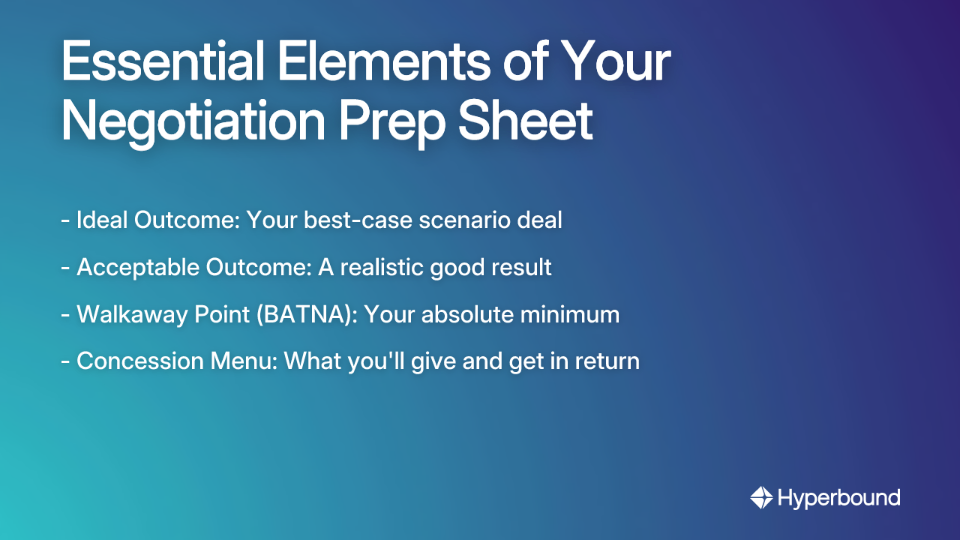
- Ideal Outcome: The best-case scenario (e.g., full price, 3-year contract, case study)
- Acceptable Outcome: A good, realistic outcome (e.g., 10% discount for a 3-year contract)
- Walkaway Point (BATNA): The absolute minimum you'll accept. Knowing this gives you the power to walk away from a bad deal.
- Concession Menu: Create a table with potential "gives" paired with corresponding "gets":
.png)
This exercise operationalizes the vital "give to get" principle highlighted by experienced sales professionals as essential for maintaining control in negotiations.
Exercise 5: Build Trust by Practicing Strategic Empathy
Understanding and acknowledging the other party's perspective creates a collaborative atmosphere that leads to better outcomes. This approach counters the fear of appearing like a pushy salesperson.
How to Practice:
- During role-play exercises, dedicate one round where your only goal is to articulate the prospect's problem better than they can.
- Use these empathy-building phrases:
- "It sounds like you're under a lot of pressure to hit your deadline, and the last thing you need is a complex implementation. Is that right?"
- "I can see why you'd be concerned about the budget, especially given the current economic climate."
- "That's a challenging situation. Many of our clients faced similar issues before implementing our solution."
- Practice the "perspective shift" technique:
- For 2 minutes, argue passionately for the prospect's position
- Then, identify three legitimate concerns from their perspective
- Finally, develop responses that acknowledge these concerns while still moving the conversation forward
Exercise 6: Run Post-Mortems to Analyze Past Negotiations
Learning from experience is crucial for improvement, yet many sales teams never systematically review past negotiations to extract valuable lessons.

How to Practice:
After every significant negotiation (win or lose), complete a brief review using this structure:
- What were our objectives going in?
- What was the final outcome?
- What went well? (e.g., "I successfully tied our value to their main KPI.")
- What would I do differently next time? (e.g., "I should have asked to speak with the CFO earlier in the process.")
To scale this process, leverage platforms like Hyperbound's AI Real Call Scoring to automatically analyze and score negotiation calls against your playbook. This helps spot trends and creates a data-driven knowledge base of what works and what doesn't in different scenarios.
Exercise 7: Practice Quantifying Your Value Proposition
One of the most effective defenses against price objections is shifting the conversation from cost to value. This exercise helps sales reps articulate ROI in compelling, concrete terms.
How to Practice:
- Play the "Tenacity Target" game:
- One person names a product feature
- Going around in a circle, each person must state a benefit tied to a quantifiable business outcome
- Example: Instead of "Our software has automation features," say "Our software's automation saves the average client 10 hours per week in manual data entry, which translates to over $25,000 in reclaimed productivity per year."
- Practice asking the powerful question: "What is the cost of doing nothing? "This forces prospects to quantify the pain your solution solves, creating urgency and justifying your pricing.
Exercise 8: Master the "Give to Get" Exchange
As one sales veteran on Reddit emphasized: "Never give without getting something in return. The bigger the ask, the larger the counter."
How to Practice:
- Role-Play Concession Requests: Have one rep play a prospect who relentlessly asks for more. The sales rep must practice responding to every ask with a counter-request.
- Example Scripts:
- Prospect: "Can you give us a 15% discount?"
- Rep: "I can definitely explore what's possible on pricing. If I can get that approved, would you be willing to sign a two-year agreement instead of one? That helps us justify the discount internally."
- Prospect: "We need Net-60 payment terms."
- Rep: "We can typically be flexible on payment terms for our partners. To make that work, could we get a commitment for three introductions to other department heads in your organization? Getting those referrals is a key priority for us."
This technique is especially valuable for securing referrals, which many sales professionals find challenging to obtain without direct requests.
Put These Exercises Into Practice
Negotiation isn't an innate talent—it's a skill developed through consistent practice. By incorporating these eight exercises into your regular training routine, you'll transform your team's ability to:
- Protect profit margins while still closing deals
- Build stronger client relationships based on mutual value
- Secure valuable commitments like referrals and testimonials
- Navigate even the most challenging objections with confidence
Remember: the best negotiators aren't those who "win" at the expense of their clients. They're the ones who create such compelling value that price becomes secondary to the partnership. With these practical exercises, you'll develop the confidence and competence to negotiate from a position of strength, turning prospects into long-term partners who champion your business to others.
Book a demo with Hyperbound


