.png)


.png)
Summary
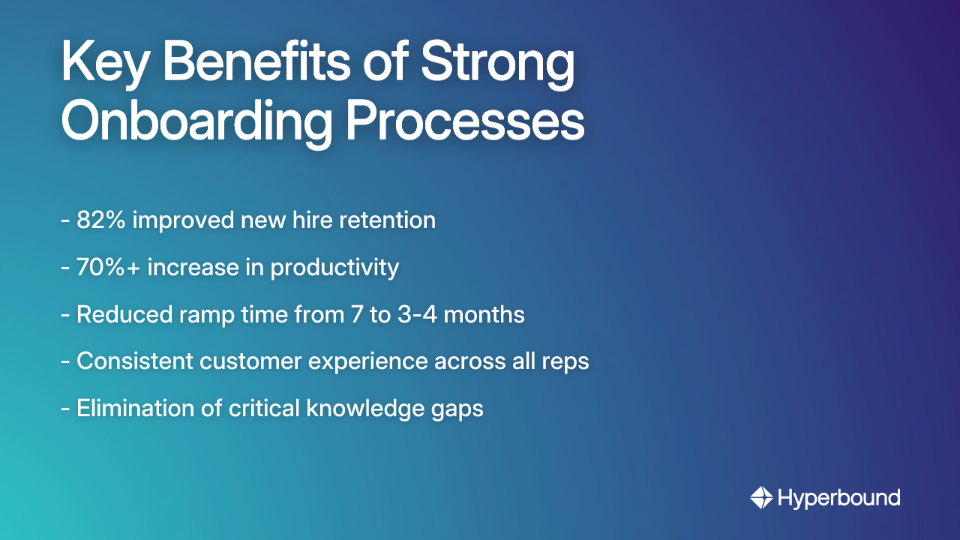
- Inconsistent sales onboarding is costly, with an average ramp time of 7 months; however, companies with strong processes boost new hire retention by 82% and productivity by over 70%.
- Sales onboarding software solves this by creating a centralized system for training content, messaging, and assessments, ensuring every rep gets the same high-quality experience.
- The key is to establish a standardized framework that provides structured yet flexible training paths, which can cut ramp time down to just 3-4 months.
- AI-powered tools like Hyperbound's AI Sales Roleplays provide a scalable way for new reps to practice crucial conversations and receive consistent, objective feedback, accelerating their readiness.
You've just hired a promising new sales rep. They arrive on day one full of energy and enthusiasm, ready to make an impact. Then you hand them a 40-page onboarding document or point them to a folder of training videos... and watch as their enthusiasm visibly drains away.
Sound familiar?
This scenario plays out in sales organizations everywhere, creating a costly paradox: the moment initial excitement meets overwhelming, unstructured information. But the real problem runs deeper than just dampened spirits. Without a system in place, every manager onboards differently. One new rep gets detailed coaching and shadowing, while another in a different territory is essentially left to figure things out alone.
The stakes couldn't be higher. According to research from the Brandon Hall Group, companies with strong onboarding processes improve new hire retention by 82% and productivity by over 70%. Yet many sales teams continue to rely on inconsistent, ad-hoc approaches to bringing new talent up to speed.
The solution? Sales onboarding software that replaces chaotic, inconsistent approaches with a centralized, scalable system for ramping up new sales reps effectively.
The Hidden Costs of an Inconsistent Sales Onboarding Program
Before we explore the solution, let's understand what inconsistent onboarding is truly costing your organization:
Prolonged Time-to-Productivity
Industry research shows it takes an average of 7 months to fully onboard a new sales rep. However, with the right structure, this can be cut down to just 3 or 4 months. That's potentially three more months of quota-hitting performance per rep—a direct impact on your bottom line.
A Confusing Experience for New Hires
As one sales leader put it, "One of the biggest things we see is how rushed it can feel to new starters." Without structure, the onboarding process feels chaotic. Inconsistencies in program branding, processes, naming conventions ("courses" vs. "modules"), and course structure confuse learners and slow their progress.
Variable Performance and Fractured Customer Experience
If reps are trained inconsistently, they will sell inconsistently. This means your customers receive different answers, see different demos, and experience your brand in disjointed ways. The result? Confused prospects, longer sales cycles, and missed opportunities.
Knowledge Gaps and Unasked Questions
"Managers need to remember that there are things they know so deeply, they may feel everyone else knows the same things (even new reps)," notes an experienced sales trainer on Reddit. Without a structured way for new hires to identify and fill knowledge gaps, critical information falls through the cracks.
What Exactly is Sales Onboarding Software?
Sales onboarding software is a specialized platform designed to streamline and standardize the training, integration, and development of new sales representatives. It serves as the "single source of truth" for your sales team, providing:
- Delivery of training content in various formats (videos, documents, interactive modules)
- Tracking of new hire progress and engagement with materials
- Assessment of performance through quizzes, certifications, and AI-powered sales roleplays that simulate real-world buyer conversations
- A centralized knowledge base for easy access to all sales resources, documentation, and best practices
Most importantly, it creates consistency in how your organization brings new sales talent up to speed—regardless of manager, team, or location.
The Blueprint for Consistency: How Software Standardizes Onboarding
Here's how sales onboarding software transforms a fragmented approach into a consistent, repeatable process:
1. Standardized Training Paths & Automated Modules
Software allows leadership to design a single, official onboarding track that every new rep follows. This ensures that critical information—from product knowledge to sales methodology—is delivered in the same sequence to every hire.
As one sales leader shared, "We train and onboard sellers using Hyperbound for the onboarding track, but we also get real-time and just-in-time AI coaching on every call, which is a game-changer."
The automation element is crucial here. Rather than relying on busy managers to remember every step, the software prompts learners to complete specific modules on schedule.
2. A Centralized Hub for Consistent Content & Messaging
All playbooks, battle cards, demo scripts, and objection-handling guides live in one place. This eliminates outdated documents saved on local drives and ensures the entire team is aligned on messaging.
"We also keep playlists of the best objection-handling moments + notes from calls updated all the time," notes one sales leader, highlighting how modern software can preserve and share best practices consistently across the organization.
3. Uniform Assessment, Certification & Readiness Tracking
Instead of subjective manager assessments, software uses standardized quizzes and certifications to objectively measure knowledge retention. This aligns with user feedback that "certs have always worked the best" for ensuring consistent understanding.
Advanced platforms like Hyperbound even offer tools like AI Real Call Scoring with customizable scorecards, ensuring reps are objectively measured against your winning methodology before they interact with prospects.
4. Scalable Coaching & Real-Time Feedback
Consistency extends to coaching. AI-powered platforms like Hyperbound enable real-time and just-in-time coaching at scale, providing new reps with instant, personalized feedback on their practice roleplays and their very first live calls.
"The only thing we need to prep is to decide what sales methodology to use, and based on that the tool scores the conversation," shares one user, highlighting how technology can create consistency in feedback and coaching.
5. Data-Driven Consistency Improvements
Onboarding software provides analytics and reporting that show where new hires are succeeding or struggling collectively. Managers can see, for example, if 80% of new reps fail the quiz on a specific product feature. This data allows for targeted improvements to the onboarding program itself, ensuring the process gets more consistent and effective over time.
Structured Flexibility: Personalization Within a Consistent Framework
It's important to note that consistency does not mean rigidity. Modern sales onboarding software avoids a one-size-fits-all approach by allowing for tailored programs while maintaining a consistent framework.
"We create separate playlists for different deal sizes, regions, etc., so they can jump straight into what matters for their role," explains a sales enablement leader. This approach acknowledges that while core product knowledge and sales methodology might be universal, an SDR focused on SMB deals needs different training than an AE handling enterprise accounts.
Today's leading platforms offer AI-powered personalized learning experiences and drip-feed targeted onboarding that adapt to the learner's pace and needs—all within the guardrails of your organization's established best practices.
Choosing Your Consistency Engine: Key Features to Look For
.png)
When evaluating sales onboarding software to solve your consistency challenges, look for these essential features:
Accessible Content
Is it mobile-friendly? Can you create playlists of real disco calls and demo calls for reps to study on the go? As one sales leader puts it, "At our company, we give them playlists of real calls categorized by disco calls, demo calls, etc." This approach is far more engaging than traditional training documents.
Robust Progression Tracking
Does it offer real-time metrics and customizable reports to measure learner activity and training effectiveness? The ability to see who's progressing and who's falling behind allows for timely intervention.
Gamification & Engagement
Does it include features like leaderboards, points, and badges to make learning engaging and combat the "boring doc" problem that drains new hire enthusiasm?
AI-Powered Practice & Coaching
Does the platform allow reps to practice in a safe environment? Look for AI-powered roleplays where reps can simulate real conversations, from cold calls to objection handling. The best tools will also provide AI-driven scoring and feedback on both practice sessions and real calls to accelerate skill development.
Intuitive User Interface
Is the platform easy to navigate so reps can focus on learning, not on figuring out the tool? Complexity will only compound the consistency problem.
Personalization & Customization
Can you easily create different onboarding tracks for different roles and teams while maintaining core consistency in your messaging and methodology?
From Fragmentation to a Unified Force
The cost of inconsistent sales onboarding is too high to ignore. When every manager takes their own approach, new hires receive variable training quality, key information gets missed, and your customers experience an inconsistent brand.
Sales onboarding software provides the essential structure, automation, and data insights to build a standardized, repeatable, and highly effective training machine. It transforms what was once a chaotic variable into a strategic advantage.
By solving the consistency problem, you empower every new sales rep to become a productive, confident contributor faster—cutting ramp time from seven months to as little as three. The result is a unified sales force that delivers a consistent brand promise, ultimately driving revenue and achieving those impressive metrics of 82% improved retention and 70% increased productivity.
Consistency may not be the flashiest aspect of sales enablement, but it might just be the most valuable. And with the right software solution, it's finally within reach.
Frequently Asked Questions
What is sales onboarding software?
Sales onboarding software is a specialized platform designed to standardize the training, development, and integration of new sales reps. It acts as a central hub for all training materials, progress tracking, performance assessments, and sales resources, ensuring every new hire receives the same foundational training.
Why is consistent sales onboarding so important?
Consistent sales onboarding is crucial because it significantly improves new hire retention and productivity. Research shows companies with strong processes see an 82% improvement in retention and a 70% boost in productivity. It also reduces ramp time, eliminates knowledge gaps, and ensures a uniform customer experience across your entire sales team.
How does software help create a consistent onboarding experience?
Software creates consistency by providing standardized training paths, a centralized content hub for messaging, uniform assessment tools like quizzes and AI-powered roleplays, and scalable coaching. This ensures that every rep, regardless of their manager or location, follows the same core curriculum and is measured against the same performance standards.
How long does it take to onboard a new sales rep?
While the industry average to fully onboard a sales rep is around 7 months, a structured program supported by sales onboarding software can cut this time down to just 3 or 4 months. By streamlining the learning process, you get reps to full productivity much faster.
What are the most important features of sales onboarding software?
Key features to look for include accessible, mobile-friendly content; robust progress tracking and analytics; gamification to boost engagement; and AI-powered tools for practice roleplays and coaching. The platform should also have an intuitive interface and allow for customization of training paths for different roles.
Can onboarding be personalized if it's standardized?
Yes, modern sales onboarding software allows for structured flexibility. You can establish a consistent core framework for universal knowledge (like product details and sales methodology) while creating personalized learning paths for different roles (e.g., SDR vs. AE) or regions. This ensures everyone gets relevant training within established company-wide best practices.
Ready to build a consistent, high-performing sales team? See how Hyperbound's AI Sales Coaching platform can cut your ramp time and ensure every rep performs like your best.
Book a demo with Hyperbound


