.png)


.png)
Summary
- Many sales teams are drowning in call data but struggle to turn it into actionable insights for revenue growth.
- Focus on quality metrics like the 40:60 talk-to-listen ratio, which correlates with top performance, rather than just call volume.
- To succeed with sales call analytics, define a specific goal, ensure your tools are integrated, and train your team to turn data into action.
- Platforms like Hyperbound use call analytics to provide objective scoring and create AI-powered roleplays, helping reps master winning behaviors identified from your team's actual conversations.
You've invested in recording your sales calls, but now you're drowning in data. Transcripts pile up unread, dashboards sit untouched, and your team still relies on gut feelings to make critical decisions. Meanwhile, leadership wants to know the ROI of your expensive new analytics platform.
Sound familiar? You're not alone. Many sales leaders feel overwhelmed by call data and there's a widespread misconception that AI analytics is just another automation tool collecting dust in your tech stack.
The truth? Sales call analytics should function as your strategic co-pilot—handling the heavy lifting of conversation analysis so your team can focus on what humans do best: decision-making and driving long-term growth.
In this article, we'll cut through the noise to explain what sales call analytics actually is, why it's a game-changer for revenue teams, and most importantly, which specific metrics actually drive revenue.
The stakes are high: the global conversation intelligence market is projected to grow exponentially as more organizations recognize its critical role in sales success.
What is Sales Call Analytics (and How Does AI Power It)?
Sales call analytics is both a technology and process that automates the monitoring of sales calls to extract granular data and understand conversations at scale. Unlike basic call recording, modern analytics platforms use artificial intelligence to transform raw conversations into actionable business intelligence.
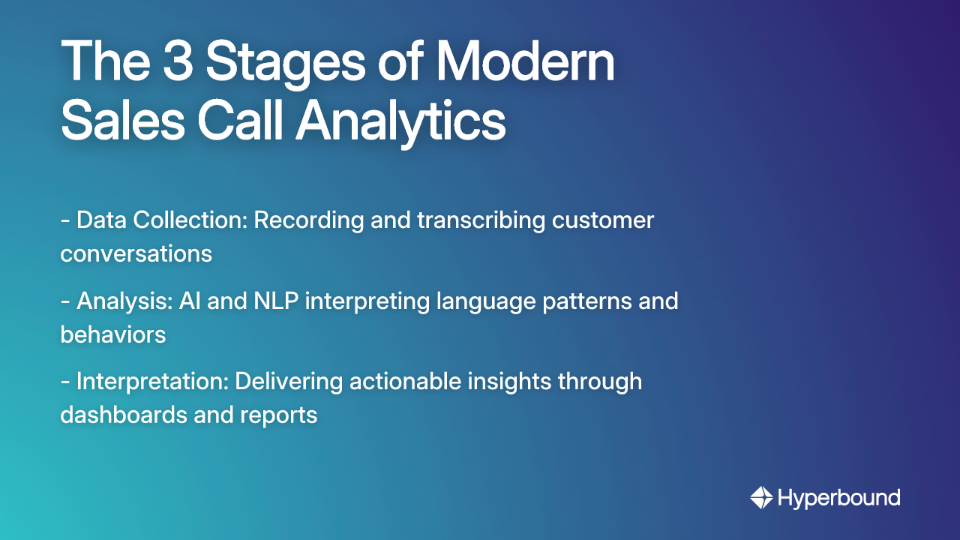
This process typically follows three key stages:
1. Data Collection
The system records and transcribes calls in real-time or batches, creating a searchable database of every customer interaction.
2. Analysis
This is where AI and Natural Language Processing (NLP) do the heavy lifting. The software transcribes calls, interprets language patterns, and tags important topics, sentiments, and behaviors. It's worth noting that while NLP technology has advanced significantly, human review can still help validate interpretations for maximum accuracy.
3. Interpretation
The platform delivers dashboards and reports with actionable insights, highlighting patterns across hundreds or thousands of conversations that would be impossible to spot manually. Platforms like Hyperbound leverage this process to deliver personalized AI coaching and hyper-realistic roleplay scenarios based on your team's actual sales conversations.
What makes modern sales call analytics truly powerful is its multi-layered approach to understanding your sales data:
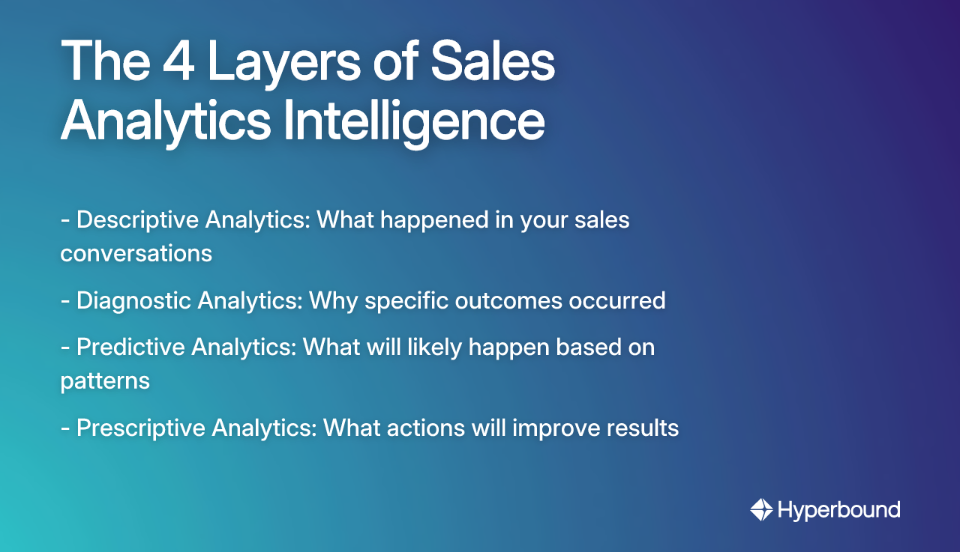
Descriptive Analytics (What happened?): Tracks historical data like revenue figures and closed deals.
Diagnostic Analytics (Why did it happen?): Analyzes root causes, focusing on elements like customer sentiment and objection patterns.
Predictive Analytics (What will happen?): Uses historical data to forecast revenue streams and identify patterns, reducing uncertainty in predictions.
Prescriptive Analytics (What should we do?): Provides actionable recommendations to improve sales workflows and outcomes.
The market is voting with its wallet: a rapidly growing number of sales teams are now using AI call recording and analysis. But what exactly makes this technology such a revenue driver?
Why Sales Call Analytics is a Revenue-Driving Game-Changer
Objective Performance Evaluation
Say goodbye to the biases inherent in manual call reviews. Analytics provides data-backed insights that pinpoint specific coaching opportunities for each rep. With a tool like Hyperbound, you can use AI Real Call Scoring to automatically grade performance against your playbook. This addresses one of the biggest challenges sales leaders face: objectively measuring agent performance and identifying targeted improvement areas.
Unlock Deep Customer Intelligence
Analytics goes beyond surface-level feedback to reveal recurring issues, customer pain points, successful sales tactics, and sentiment trends over time. These insights can be used to refine messaging and even guide product development decisions.
As one sales leader noted on Reddit: "Success depends on clean data, proper integration, and teams trained to act on the insights." When properly implemented, these systems transform scattered feedback into structured intelligence.
Optimize the Entire Sales Process
Use data-driven insights to identify common objections, see which parts of your script are working, and streamline the entire sales cycle for greater efficiency. Instead of making changes based on anecdotes, you can implement improvements based on patterns across hundreds or thousands of calls.
Enhance Lead Qualification and Response Time
Analytics can detect buying signals and engagement levels, allowing teams to prioritize leads more effectively. This highlights the importance of Lead Response Time—ideally within 5 minutes—which significantly boosts conversion chances compared to delayed follow-ups.
Accelerate Rep Training and Onboarding
Reduce the learning curve for new hires by letting them learn from a library of successful calls. Modern platforms like Hyperbound take this a step further, using insights from top performers to create AI Sales Roleplays. This allows reps to practice critical conversations in a safe environment and master best practices before they ever speak to a live prospect.

The Metrics That Actually Matter: From Activity to Impact
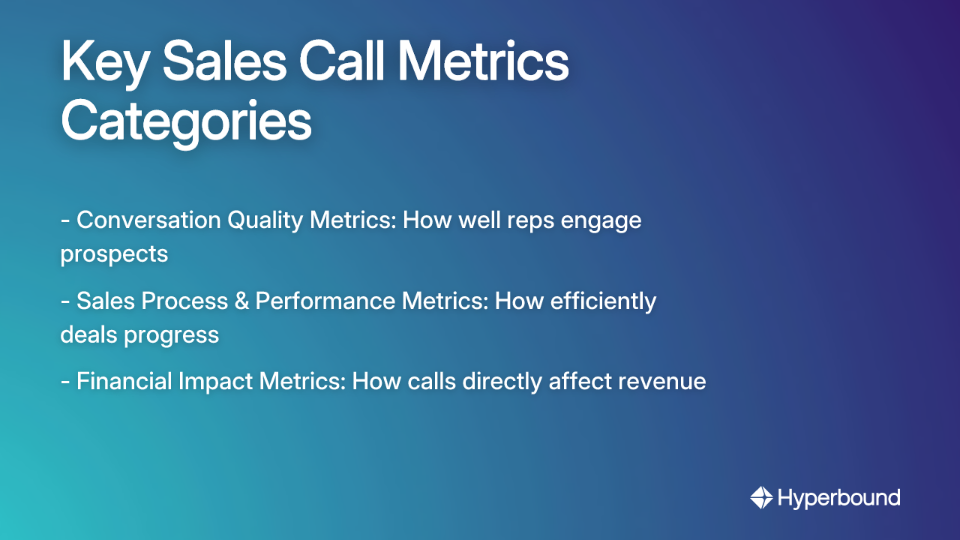
Not all sales call metrics are created equal. Here are the ones that genuinely move the needle on revenue, organized into practical categories:
Conversation Quality Metrics
Talk-to-Listen Ratio: This crucial indicator measures how much your reps talk versus listen during calls. The optimal ratio is 40:60, meaning reps should listen more than they talk to better understand customer needs. Top performers consistently hit this balance, while struggling reps often dominate conversations.
Sentiment Analysis: AI tools can gauge the emotional tone (positive, negative, neutral) throughout a call, providing a real-time indicator of customer reactions. Tracking sentiment shifts during specific topics or objection handling can reveal powerful insights about your messaging effectiveness.
Objection Rate & Handling: Track both the frequency and nature of objections. This data is invaluable for refining scripts and preparing reps for common hurdles they'll face in conversations.
Average Call Duration: While not a standalone metric, longer calls often correlate with higher prospect engagement. This should be analyzed alongside conversion data to identify optimal conversation lengths for your specific sales process.
Sales Process & Performance Metrics
Lead Response Time: The time elapsed between a lead's inquiry and the first contact. Faster is almost always better, with research showing dramatic drops in conversion rates after just minutes of delay.
Call-to-Meeting Conversion Rate: The percentage of initial calls that successfully lead to a scheduled meeting or product demo—a critical milestone in most B2B sales processes.
First Call Close Rate: A powerful measure of sales effectiveness. What percentage of deals are closed on the very first contact? This metric helps identify your most efficient paths to revenue.
Win Rate: The ultimate performance metric.
- Formula: (Number of New Customers ÷ Total Number of Opportunities) × 100
- Example: 50 new customers from 200 opportunities is a win rate of 25%
Financial Impact Metrics
Average Deal Size: Helps with revenue forecasting and identifying which types of leads are most valuable to your business.
Customer Acquisition Cost (CAC): Calculates the average cost to acquire a new customer through sales activities, essential for understanding profitability.
Revenue Generated from Calls: Directly ties sales call efforts to financial outcomes, proving the ROI of your team and tools.
How to Implement Sales Call Analytics for Maximum Impact
1. Start with Clear, Measurable Objectives
Don't just "analyze calls." Set specific goals like "increase win rate by 10% in Q3" or "reduce new rep ramp-up time by 25%." Your objectives will guide which metrics deserve the most attention.
2. Prioritize Data Quality & Integration
As many sales leaders will attest, "Success depends on clean data, proper integration, and teams trained to act on the insights." Ensure your analytics platform integrates seamlessly with your CRM to provide a complete view of the customer journey.
3. Choose the Right Tool for Your Team
Popular options include Hyperbound, Gong, Clari, Salesify, Happysales, and Fireflies.ai. When selecting a platform:
- Define Your Primary Goal: Are you focused on rep coaching, forecast accuracy, or market intelligence?
- Understand True Cost of Ownership: Look beyond per-seat pricing to include platform fees and add-ons.
- Check for Workflow Integration: Ensure the tool fits smoothly into your existing sales tech stack.
- Plan for Compliance & Adoption: Address legal consent (like GDPR) and frame the tool as a coaching aid, not a surveillance device.
4. Train Your Team to Turn Insights into Action
An analytics platform is useless if no one acts on the data. Reinforce the idea of AI as a co-pilot, not a replacement for human judgment. Use analytics to build a culture of continuous improvement through self-evaluation and data-driven team reviews.
5. Foster Cross-Functional Collaboration
Share insights beyond the sales team. Customer intelligence from call analytics can help align sales, marketing, support, and product teams to break down silos and build better customer experiences.
Conclusion: From Gut Feelings to Revenue Growth
Sales call analytics has evolved from a simple recording tool to an indispensable part of the modern revenue engine. The shift from intuition-based selling to making data-driven decisions leads to measurably improved performance, enhanced customer satisfaction, and sustainable growth.
If you're just getting started, begin by defining one key objective and exploring a tool that can help you achieve it. Remember that AI serves as your strategic co-pilot—handling the data analysis so your team can focus on what humans do best: building relationships and driving business growth.
The future of sales belongs to teams that can effectively harness conversation intelligence to understand their customers better than the competition. With the right metrics and implementation strategy, sales call analytics doesn't just monitor performance—it transforms it.
Frequently Asked Questions
What is sales call analytics?
Sales call analytics is a technology and process that uses artificial intelligence (AI) to automatically record, transcribe, and analyze sales conversations to extract actionable business insights. It goes beyond simple call recording by using Natural Language Processing (NLP) to interpret language patterns, identify customer sentiment, track key topics, and highlight coaching opportunities, transforming raw call data into strategic intelligence.
How does sales call analytics improve sales performance?
Sales call analytics improves performance by providing objective, data-driven insights into what works in sales conversations, enabling targeted coaching, and optimizing the entire sales process. It helps leaders objectively evaluate rep performance, uncover deep customer intelligence like common pain points and buying signals, identify best practices from top performers, and streamline training. This leads to higher win rates, shorter sales cycles, and increased revenue.
What are the most important sales call metrics to track?
The most important metrics go beyond simple activity tracking and focus on conversation quality, process efficiency, and financial impact. Key metrics include the talk-to-listen ratio (aiming for 40:60), customer sentiment analysis, objection handling rate, call-to-meeting conversion rate, and ultimately, financial metrics like win rate and average deal size.
How can I implement sales call analytics without making my team feel spied on?
Position the technology as a coaching and development tool, not a surveillance device, by focusing on its benefits for personal and team growth. Frame the analytics platform as an "AI co-pilot" designed to help reps improve their skills, learn from successful calls, and close more deals. Emphasize transparency in how the data is used and involve the team in the process to build trust and encourage adoption.
Is sales call analytics only for large enterprises?
No, sales call analytics is valuable for businesses of all sizes, from startups to large enterprises. While large enterprises can analyze massive datasets, smaller teams can gain significant advantages by understanding customer conversations, ensuring playbook consistency, and accelerating the onboarding of new hires. Many modern platforms offer scalable pricing models suitable for smaller teams.
What is the first step to get started with sales call analytics?
The first step is to define a clear, measurable business objective you want to achieve. Instead of vaguely wanting to "analyze calls," set a specific goal, such as "increase the call-to-meeting conversion rate by 15%" or "identify the top 3 customer objections in the next quarter." This specific goal will guide your tool selection and help you focus on the metrics that matter most from day one.
Book a demo with Hyperbound


