.png)


.png)
Summary
- Most SDR training fails due to a weak foundation; ensure dedicated leadership, a solid tech stack, and documented processes are in place before hiring your team.
- Effective training must develop both hard skills like tech mastery and hyper-personalization, alongside crucial soft skills such as resilience and active listening.
- Shift from a one-time onboarding event to a continuous coaching culture by using call reviews, building a library of best practices, and establishing clear career paths.
- To combat call reluctance and scale practice, leverage tools like Hyperbound's AI Sales Roleplays to provide reps with a safe, repeatable environment to build confidence.
You've hired a team of Sales Development Representatives (SDRs) with high hopes and aggressive targets. But three months in, half are struggling to hit quota, one just quit after an embarrassing call with a prospect, and the rest are so anxious about making calls they're spending most of their time "researching." Sound familiar?
Many sales leaders are shocked to discover that raw talent and a positive attitude aren't enough to build a successful SDR team. As one sales leader shared on Reddit, "I remember listening to a rep on the phone trying to discuss 'COLD BALL' vs COBOL. It was embarrassing." This wasn't a personal failing—it was a training failure.
The truth is, most SDRs are set up to fail before they even start. They're thrown into high-pressure environments with minimal preparation and expected to perform immediately. It's no wonder that research shows many new hires are "so paralyzed with fear they could barely speak their name or remember anything."
This article provides a comprehensive blueprint for building an SDR training program that doesn't just help reps survive—it helps them thrive. Whether you're revamping an existing program or building one from scratch, you'll learn how to create a system that consistently produces top performers who hit quota, develop confidence, and grow into future sales leaders.
The Foundation: Why Most SDR Training Fails Before It Even Starts
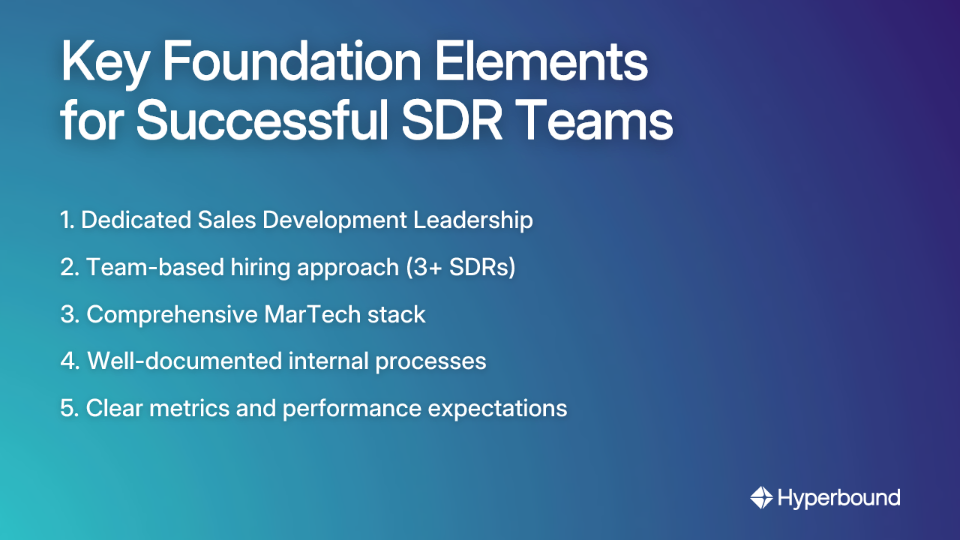
Before diving into curriculum design, it's crucial to understand that effective training requires the right foundation. According to Punch B2B, many in-house SDR teams fail due to foundational errors that no amount of training can overcome:
Hire Leadership First
One of the biggest mistakes companies make is hiring SDRs before establishing proper leadership. Without a dedicated Sales Development Manager who understands the role, you're setting your team up for failure. This leader should establish clear processes, define the go-to-market strategy, and provide day-to-day guidance that no training manual can replace.
Build a Team, Not Just Hire Individuals
SDR success is rarely a solo endeavor. The most effective programs hire at least three SDRs simultaneously to create a supportive, competitive environment where reps can learn from each other. Consider complementary roles like Data Researchers and MarTech Managers to support your SDR function.
Invest in Your MarTech Stack
No matter how well-trained your SDRs are, they'll struggle if they don't have the right tools. Your tech stack should include:
- A robust CRM system
- Sales engagement platforms
- Prospecting tools
- Call analytics software
- Email automation capabilities
Before training begins, ensure these tools are properly integrated and ready for use. As Punch B2B notes, a poor MarTech stack is one of the main reasons SDR teams fail to gain traction.
Document Internal Processes
Clear documentation is the backbone of effective training. Before bringing on new SDRs, document your processes for:
- CRM usage and data entry
- Lead qualification criteria
- Handoff procedures to Account Executives
- Performance metrics and reporting
- Communication channels
This prevents the all-too-common friction over "poor lead quality" and ensures consistent execution across the team.
The Blueprint for a High-Impact SDR Onboarding Program
With the foundation in place, it's time to design your onboarding program. This is where you address the primary pain point many SDRs face: "If you need training on anything, it's the Market/Product." According to SalesRoads, an effective onboarding structure includes:
Week 1: Deep Dive into the Essentials
Company & Product Knowledge Don't settle for surface-level overviews. New SDRs need to understand:
- Your company's history and mission
- Detailed product features and benefits
- Key differentiators from competitors
- Specific pain points your solution addresses
- Industry terminology and jargon
The Sales Process Introduce your sales methodology and the tools that support it:
- CRM navigation and data entry protocols
- Prospecting and lead qualification criteria
- Your specific sales playbook
- Time management expectations
- Automation tools and when to use them
The Prospect Provide a comprehensive breakdown of your ideal customer profile:
- Key job titles and decision-makers
- Industry verticals you target
- Common challenges and pain points
- Buying signals to watch for
- Typical objections they raise
Week 2: The Competitive Landscape and Practical Application
Competition Equip your SDRs with competitive intelligence:
- Major competitors and their positioning
- Competitor strengths and weaknesses
- How to position your solution against alternatives
- Common competitive objections and responses
Role-Play and Practice Begin building confidence through structured, scalable practice:
- AI-Powered Roleplays: While traditional internal role-plays have value, they are time-consuming and hard to scale. Modern teams leverage AI platforms like Hyperbound to let reps practice critical conversations with hyper-realistic AI buyer personas. This provides a safe, repeatable environment to master everything from cold calls to objection handling.
- Call Recording Reviews: Analyze recordings of both real and practice calls to identify areas for improvement.
- Objection Handling Drills: Use insights from call reviews and role-plays to run workshops focused on overcoming specific objections.
Build a Permanent Library of Training Resources
Create a centralized, accessible repository of training materials that SDRs can reference at any time:
- Your comprehensive sales playbook
- Call and email scripts and templates
- Recordings of successful calls
- Objection handling guides
- Product and feature updates
- Competitive battle cards
As one Reddit user noted, having access to these resources helps prevent embarrassing situations like the rep who tried to discuss "COLD BALL" instead of COBOL during a call.
The Core Curriculum: Essential Hard and Soft Skills for the Modern SDR
.png)
Effective SDRs need a blend of technical proficiency and interpersonal skills. According to pclub.io and SalesRoads, your curriculum should cover:
Hard Skills (The 'What')
Tech Mastery Train SDRs to proficiently use:
- Your CRM system (Salesforce, HubSpot, etc.)
- Sales engagement platforms (Outreach, SalesLoft)
- LinkedIn Sales Navigator
- Call analytics tools
- AI and automation for prospecting
Data-Driven Account Prioritization Teach SDRs to strategically focus their efforts using:
- Firmographic data analysis
- Buyer intent signals
- Lead scoring methodologies
- Engagement metrics interpretation
Hyper-Personalization Generic outreach is dead. According to McKinsey, over 70% of customers expect personalized interactions. Train SDRs to:
- Conduct in-depth prospect research
- Customize messaging based on each buyer's situation
- Leverage social insights for relevance
- Use personalization at scale tools effectively
Research Skills Develop the ability to quickly gather relevant information:
- Company research techniques
- Finding decision-makers
- Identifying buying signals
- Understanding industry trends
Soft Skills (The 'How')
Resilience The ability to handle rejection is crucial. Teach strategies for:
- Maintaining a positive mindset
- Learning from rejection
- Developing a growth mindset
- Building emotional intelligence
Active Listening Train SDRs to listen more than they talk:
- Asking powerful open-ended questions
- Reading between the lines
- Identifying pain points from conversations
- Taking effective notes during calls
Coachability Perhaps the most important soft skill for long-term success:
- Openness to feedback
- Ability to implement suggested changes
- Self-awareness about strengths and weaknesses
- Continuous improvement mindset
Empathy & Critical Thinking The ability to understand prospects' world and analyze situations:
- Putting yourself in the buyer's shoes
- Understanding business challenges
- Connecting solutions to specific needs
- Making compelling business cases
Beyond Onboarding: 9 Strategies for Continuous Coaching and Development
Training isn't a one-time event—it's an ongoing process. Orum recommends these nine strategies for continuous development:
1. Use AI Call Scoring for Targeted Insights
Move beyond subjective feedback. Use AI-powered tools like Hyperbound's Real Call Scoring to automatically score conversations against your sales methodology. This provides objective data and helps track metrics like:
- Talk-to-listen ratio
- Monologue duration
- Question frequency
- Filler word usage
These objective measures help identify specific areas for improvement.
2. Build a Call Library
Create a repository of "greatest hits" calls tagged by scenario:
- "Objection handling - pricing"
- "Securing the meeting"
- "Qualifying the prospect"
- "Handling gatekeepers"
This gives SDRs real-world examples to learn from.
3. Incorporate Live Call Shadowing
Use tools that let managers listen to live calls and provide real-time feedback via private channels. This builds confidence with a safety net.
4. Scale Practice with AI Role-Plays
While using recorded calls for 1:1 role-play is a good start, it doesn't scale. Instead, leverage AI to turn your best (and worst) call recordings into interactive role-play scenarios. Platforms like Hyperbound allow you to create a library of AI-powered simulations based on real-life conversations, providing reps with realistic, on-demand practice that doesn't require a manager to be present.
5. Develop Personalized Learning Paths
Use performance data to create structured, individual development plans:
- Track progress against core skills
- Set personalized improvement goals
- Schedule regular check-ins
- Celebrate milestone achievements
6. Enhance Objection-Handling Skills
Run regular workshops focused on tackling common objections. Document responses to frequent pushbacks in your call library.
7. Deliver Scalable AI Coaching
Leverage AI to provide personalized coaching at scale. Instead of managers spending hours manually reviewing a small fraction of calls, an AI Coaching platform can automatically analyze every conversation. It can score calls against your playbook and provide reps with instant, actionable feedback, helping them correct mistakes in real-time and freeing up managers for more strategic coaching on high-stakes deals.
8. Promote a Culture of Feedback
Encourage SDRs to review their own call recordings with a structured approach:
- What went well?
- What could be improved?
- What will they do differently next time?
9. Integrate External Courses (Wisely)
While some external courses are just "dream selling" as noted by Reddit users, others can be valuable. Blend vetted external training from providers like SDR Nation or certifications like the Salesforce Professional SDR Certificate with your internal processes.

Measuring What Matters: KPIs and Career Paths That Retain Top Talent
A great training program becomes a retention tool when SDRs can see its impact on their performance and future.
SDR Evaluation Beyond Raw Numbers
Move beyond just "meetings booked." Track:
- Reply rates
- Conversation-to-meeting conversion
- Quality of leads passed to AEs
- Pipeline generated
Conduct regular reviews to discuss KPIs and improvement strategies.
Creating Clear Career Paths
As noted in Reddit discussions, companies like Oracle and Cisco have programs to take BDRs to AE roles over 18-24 months. Clearly document potential paths:
- SDR → Senior SDR → AE
- SDR → Sales Operations
- SDR → Customer Success
- SDR → Sales Enablement
Provide development opportunities aligned with these paths, such as advanced sales training or mentorship from senior AEs.
From Training Program to Performance Engine
Building a team of top-performing SDRs isn't about a single training course or magical playbook. It's about creating a continuous learning environment—a performance engine—that empowers reps with the skills, confidence, and vision to succeed.
The most successful programs combine:
- A solid foundation (people, tech, process)
- Structured onboarding
- Essential hard and soft skills training
- Commitment to continuous coaching
- Clear measurement and career growth opportunities
By implementing these elements, you'll not only avoid the embarrassing "COLD BALL" moments but build a team of confident, capable SDRs who consistently exceed targets and grow into your company's future sales leaders.
Frequently Asked Questions
What are the essential components of a successful SDR training program?
A successful SDR training program is built on five key pillars: a solid foundation, structured onboarding, core skills development, continuous coaching, and clear career paths. Before training begins, you must have strong leadership, a well-defined tech stack, and documented processes. The training itself should cover hard skills like tech mastery and personalization, as well as soft skills like resilience and active listening, supported by ongoing coaching and measurable performance metrics.
How long should SDR onboarding last?
A structured initial onboarding program for SDRs typically lasts one to two intensive weeks. However, this is just the beginning. Effective training is an ongoing process of continuous development. The first two weeks should focus on foundational knowledge (product, market, tools), while subsequent months should be dedicated to continuous coaching, skill refinement, and advanced training through methods like AI-powered role-plays and call reviews.
Why do most SDR training programs fail?
Most SDR training programs fail due to foundational weaknesses, not curriculum flaws. The most common reasons for failure include hiring SDRs before establishing dedicated sales development leadership, not investing in an adequate MarTech stack, and lacking clearly documented internal processes for lead qualification and handoffs. Without this foundation, even the best training content cannot overcome a chaotic and unsupported environment.
What is the best way for SDRs to practice sales calls?
The most effective and scalable way for SDRs to practice sales calls is by using AI-powered role-play platforms. While traditional methods like manager-led role-plays and call reviews are valuable, they are time-consuming and difficult to scale. AI simulations provide a safe, repeatable, and on-demand environment where reps can practice handling objections, mastering their pitch, and building confidence without risking live deals.
How can you measure the effectiveness of SDR training?
To measure the effectiveness of SDR training, you should look beyond just the number of meetings booked. A comprehensive evaluation includes tracking key performance indicators (KPIs) like email reply rates, conversation-to-meeting conversion rates, the quality of leads passed to Account Executives, and the total pipeline generated. Combining these quantitative metrics with qualitative feedback from call reviews and coaching sessions provides a complete picture of an SDR's progress and the program's impact.
What are the most important skills for an SDR?
The most important skills for a modern SDR are a blend of hard and soft skills. Essential hard skills include technical proficiency with the sales stack (CRM, engagement platforms), data-driven account research, and the ability to write hyper-personalized outreach. Equally crucial soft skills include resilience to handle rejection, active listening to uncover prospect pain points, coachability for continuous improvement, and empathy to build rapport.
How can AI improve SDR coaching?
AI can dramatically improve SDR coaching by providing scalable, objective, and immediate feedback. AI coaching platforms automatically analyze every sales call to score performance against a set playbook, track key metrics like talk-to-listen ratios, and identify specific areas for improvement. This allows managers to move beyond manually reviewing a few calls and instead provide data-driven, personalized coaching to their entire team, helping reps correct mistakes faster and more effectively.
Book a demo with Hyperbound


