.png)


.png)
You've done the research, you've landed the meeting, and you can tell this is a perfect fit. The conversation is flowing, and in your excitement, it happens. You start piling questions on top of each other and sort of answering for them as you add more questions. Sound familiar? This is a direct quote from a salesperson on Reddit, and it describes a common mistake that sabotages countless deals: question-stacking.
Question-stacking happens when you ask multiple questions in rapid succession without giving your prospect time to fully respond. It's the act of asking several questions at once due to nervousness, haste, or over-enthusiasm, which completely derails your information-gathering process and, ultimately, your sale.
The stakes are high. As one sales professional noted, "All it takes is the customer to think we're not listening to start disengaging from the sale." And once that happens, bringing them back is nearly impossible.
In this article, you'll learn how to stop sabotaging your own success with practical strategies for proper pacing, the art of active listening, and how to embrace silence as your most powerful sales tool.
Why We Question-Stack: The Psychology of Self-Sabotage
Before we can fix the problem, we need to understand what causes it. There are three main culprits behind question-stacking:
Excitement: Your genuine passion for your product can make you eager to share everything at once. You see a perfect fit and want to rush to the solution.
Nervousness: The fear of awkward pauses drives you to fill every second with words, even when silence would be more productive.
Fear of Losing Control: A desire to steer the conversation can lead to firing off questions without waiting for responses, as if checking boxes on a mental checklist.
Here's what question-stacking looks like in action:
"What is your relationship with your current provider like? How do you feel they understand your business needs? And what about their response times—are you satisfied with how quickly they get back to you?"
The outcome? The prospect feels overwhelmed, confused about which question to answer first, and typically responds to only the last (and often least important) question. Valuable information remains undiscovered, and the conversation feels more like an interrogation than a collaborative discussion.
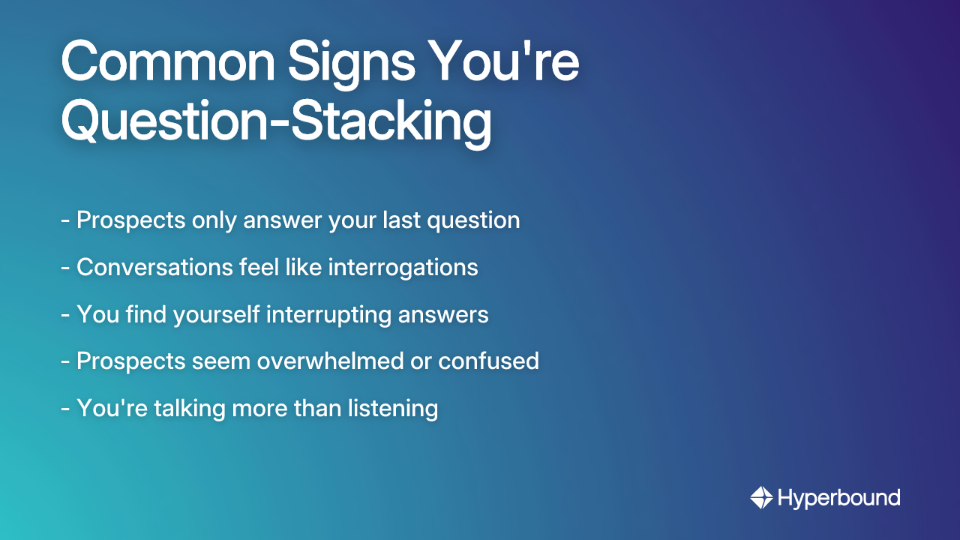
When you question-stack, you signal that you're more interested in your own agenda than in the prospect's problems. You prevent yourself from uncovering the deep, nuanced challenges they're facing, and you miss the opportunity to position yourself as a thoughtful advisor rather than just another pushy salesperson.
The Antidote: Pacing, Purpose, and Nurturing Questions
The solution to question-stacking begins with understanding the importance of pacing. A sales conversation isn't a race—it's a dance. You must learn to read customer signals to adjust your pace accordingly.
According to sales experts, factors influencing a prospect's decision-making pace include urgency (how quickly they need a solution) and personality (e.g., impulse buyers versus discerning shoppers). By tuning into these signals, you can match their rhythm instead of rushing ahead.
The "One Question" Rule
The simplest and most effective technique is to implement what I call the "One Question" rule:
- Ask one clear, meaningful question
- Then stop talking
- Allow the prospect to respond fully before moving on
Pro Tip: Before your call, prepare a few key, high-impact questions in advance to avoid asking filler questions out of nervousness. Think of these as your springboard questions—thoughtfully designed inquiries that launch your prospect into detailed explanations.
Use Softeners Before Direct Questions
User research shows that direct questions can feel "abrasive by nature." This is where the concept of a nurturing statement comes in—a softener that precedes your question to create a more comfortable environment for the prospect to share.
Examples of effective nurturing statements:
- "That's a really interesting point about your workflow. To help me understand better, can you walk me through...?"
- "I appreciate you sharing that challenge. Could you elaborate on how that impacts your team's quarterly goals?"
This approach demonstrates empathy and creates psychological safety, encouraging more honest and detailed responses.

The Power of Question Types
The structure of your questions dramatically affects the quality of your prospect's responses:
Closed-ended questions (yes/no questions) often shut down conversations. They typically begin with "Do you," "Are you," or "Have you" and limit the prospect's response options.
Open-ended questions, on the other hand, invite detailed answers and typically start with "What," "How," or "Why." These questions help you peel back the layers of the onion to get to deeper insights.
Consider this powerful, thought-provoking open-ended question: "What is one thing you could do in the next 12 months that would dramatically impact your sales?" This type of question requires contemplation and naturally creates space for a thoughtful response.
From Talking to Connecting: Mastering Active Listening
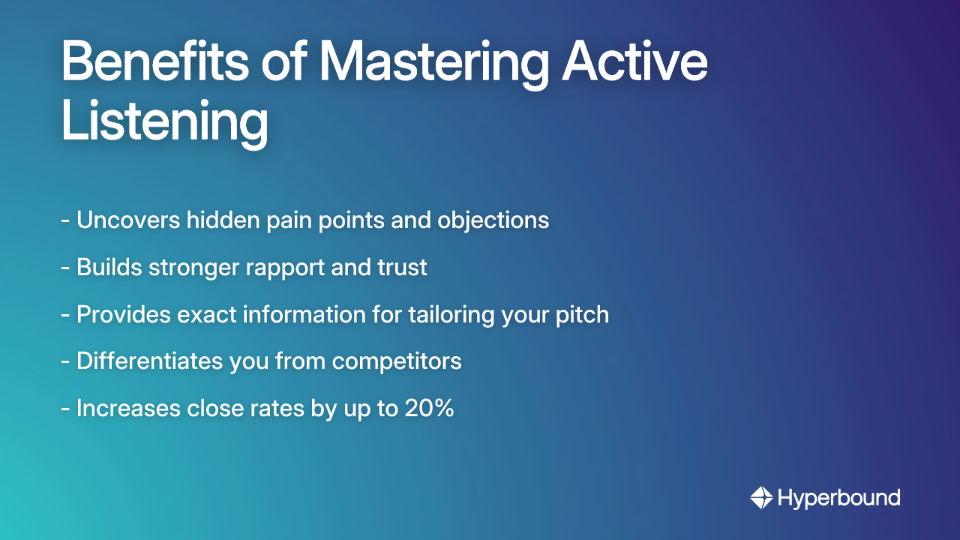
Active listening is perhaps the most underrated skill in sales. It's not just waiting for your turn to speak; it's listening to truly comprehend the prospect's problems, beliefs, and emotions.
When you practice active listening, you:
- Make prospects feel valued, building instant rapport and trust
- Transform pitches into conversations, allowing you to tailor your solution directly to their expressed needs
- Build unshakeable trust by remembering small details and providing verbal affirmations that show you care
According to sales experts, the ideal listening ratio is 70/30—you should be listening 70% of the time and speaking only 30% of the time. This approach ensures you fully grasp the prospect's needs while demonstrating that you value their input more than your own voice. Platforms like Hyperbound's AI Real Call Scoring can even analyze your talk-to-listen ratio to provide objective feedback, helping you master this critical balance.
A 3-Step Framework for Active Listening
- Acknowledge: Listen without a pre-existing agenda. Validate their concerns with phrases like, "That sounds incredibly frustrating."
- Confirm: Paraphrase what you've heard to ensure clarity. "So, if I'm understanding you correctly, the main bottleneck is the manual data entry, which costs your team about 10 hours a week. Is that right?"
- Ask Open-Ended Follow-Ups: Encourage them to elaborate further on their goals and challenges. "Could you tell me more about what an ideal solution would look like for you?"
This framework allows you to demonstrate that you're truly listening while gathering the rich, detailed information you need to position your solution effectively.
Your Most Powerful Tool: The Strategic Use of Silence
Many salespeople fear silence. They rush to fill it with more words, more questions, more selling points—often talking themselves out of a sale they might have closed if they'd just stopped talking.
Instead of viewing silence as an awkward void to be filled, reframe it as a strategic tool for gathering information and creating influence. This is where the real finesse of sales comes into play.
The 8-10 Second Rule
After you ask a powerful, open-ended question, resist the urge to jump in and rescue the prospect from having to think. The average salesperson waits only 2-3 seconds before speaking again, but this isn't enough time for the prospect to formulate a thoughtful response.
Force yourself to wait for 8-10 seconds after asking an important question. This gives the prospect time to think deeply and provide a much more valuable response. If the silence feels uncomfortable, you can say, "Take all the time you need to respond."
This technique is particularly effective with a quiet assumptive close, where you make your offer and then remain silent, allowing the prospect to come to their own decision without additional pressure.
The Psychology Behind Silence
The power of silence in sales conversations is backed by solid psychological principles:
Cognitive Dissonance: When silence follows a proposal, it creates a mental tension that can nudge the prospect to agree with your position just to resolve the discomfort.
Engaging the "Slow Brain": Silence encourages more thoughtful, deliberate consideration from the prospect, allowing them to tap into what psychologist Daniel Kahneman calls "System 2" thinking—the more analytical, reflective mode of thought.
When to Deploy Strategic Silence
- The Thoughtful Pause: After you present your price or a key proposal, say nothing. Let them be the first to speak. This is a cornerstone of Sandler thinking, which emphasizes the importance of letting prospects process information at their own pace.
- The Power Switch: After a prospect asks you a tough question, pause before answering. It projects confidence and control while giving you time to formulate a thoughtful response.
- Silent Encouragement: When a prospect is sharing something important, maintain eye contact and nod to encourage them to continue without verbal interruption. This often leads to them revealing even more valuable information.
Transform from Saboteur to Strategic Advisor
By now, you understand how question-stacking can sabotage your sales efforts and what to do instead. Let's recap the big general rules that will transform your sales conversations:
- Stop Question-Stacking: Ask one clear, open-ended question at a time. Give it room to breathe and work its magic.
- Listen More Than You Talk: Use the active listening framework (Acknowledge, Confirm, Ask) to build trust and gather deeper insights. Remember the 70/30 rule—listen more than you speak.
- Embrace the Pause: Use the 8-10 second rule to unlock deeper insights and gain a strategic advantage. Silence isn't awkward; it's powerful.
On your very next sales call, I challenge you to try just one of these techniques. After you ask your most important, goal-oriented questioning, silently count to eight in your head. Resist every urge to speak. See what happens. You'll be surprised by the depth of the response you receive.
By slowing down, listening intently, and using silence strategically, you shift from being just another excited salesperson to becoming a trusted, thoughtful advisor. That's how you stop sabotaging deals and start building lasting, profitable relationships with your prospects.
Remember, in sales, sometimes the most powerful thing you can do is simply ask a good question—and then shut up and listen to the answer.
Frequently Asked Questions
What is question-stacking in sales?
Question-stacking is the common mistake of asking multiple questions in rapid succession without giving the prospect enough time to respond. This often overwhelms the prospect, who may only answer the last question asked, causing you to miss out on valuable information and potentially derailing the sale.
Why do salespeople stack questions?
Salespeople typically stack questions due to three main psychological triggers: excitement about their product, nervousness about conversational pauses, or a fear of losing control of the sales conversation. These factors lead them to rush and fire off questions without waiting for thoughtful responses.
How can I stop question-stacking during a sales call?
You can stop question-stacking by implementing the "One Question" rule: ask a single, clear question and then stop talking. Additionally, practicing active listening, embracing strategic silence for 8-10 seconds after a question, and preparing a few key questions before the call can help you maintain proper pacing and control.
What is the difference between open-ended and closed-ended questions?
Closed-ended questions can typically be answered with a simple "yes" or "no" and often shut down conversation. Open-ended questions, which usually start with "What," "How," or "Why," encourage detailed, thoughtful responses. Using open-ended questions is key to uncovering a prospect's deeper needs and challenges.
How does active listening help close more deals?
Active listening helps you close more deals by building trust and rapport with prospects. When you listen to understand rather than just to respond, you make prospects feel valued, uncover their true pain points, and gather the specific information needed to tailor your solution directly to their needs, differentiating you from competitors.
Why is silence so powerful in sales?
Silence is powerful in sales because it creates space for the prospect to think deeply and provide more valuable, considered answers. A strategic pause of 8-10 seconds after asking an important question projects confidence, encourages the prospect to elaborate, and can even create a psychological nudge for them to agree with your proposal.

Book a demo with Hyperbound


