.png)


.png)
You've spent countless hours perfecting your product's features. Your engineering team has built an impressive technical solution with elegant architecture and robust capabilities. Yet when you present to potential customers, you're met with lukewarm responses and the dreaded "We'll think about it."
What's going wrong?
"The issue I'm having is seeing what value is," confessed one technical founder in a Reddit discussion. This sentiment echoes across boardrooms and Zoom calls throughout the tech industry. Technical professionals excel at explaining how their products work but often struggle to articulate why anyone should care.
The answer lies in a fundamental shift of perspective: Stop selling features. Start selling transformations.
The Evolution of Technical Marketing
The most successful products in today's market-saturated landscape don't just highlight technical capabilities—they paint a vivid picture of transformation. This represents an evolution in how we communicate value:
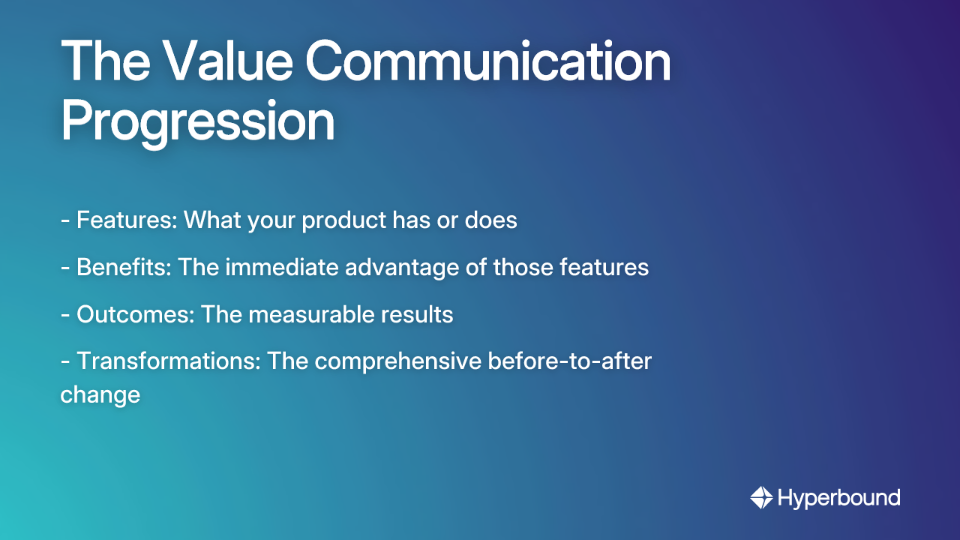
- Features: What your product has or does ("Our platform includes 12 reporting templates")
- Benefits: The immediate advantage of those features ("Save time creating reports")
- Outcomes: The measurable results ("Reduce reporting time by 75%")
- Transformations: The comprehensive change from before to after ("Transform from a data-overwhelmed manager constantly chasing information to a strategic leader with instant insights")
This progression isn't just semantic—it's the difference between being forgettable and being indispensable. As one business owner noted, "People buy trust and transformation, not just services."
Defining the Transformation: The "Before" and "After"
To sell transformations effectively, you must understand both where your customers are starting from and where they want to go. This customer-centric approach focuses on the journey rather than just the destination.
A powerful way to map this journey is through the Before & After Grid. This framework, popularized by marketing expert Ryan Deiss, helps technical professionals systematically identify the transformation their product enables:
.png)
This grid does more than organize information—it helps you identify the emotional triggers that drive purchase decisions. While technical audiences value logic and specifications, research consistently shows that buying decisions are fundamentally emotional, even in B2B contexts.
As one sales engineer observed, "It is how your product makes me feel that will trigger a buying response."
When completing this grid for your own product, don't rely on assumptions. Conduct customer interviews or surveys to gather authentic insights about their experiences. This research will reveal pain points you might never have considered and help you develop a truly customer-centric approach to your marketing.
Quantifying the Transformation: Proving Your Value with Data
Technical professionals appreciate concrete data. By quantifying the "After" state, you make the transformation tangible and undeniable. This approach addresses one of the core challenges identified in our research: "Determining true value added can be complicated by comparisons to peers."
Here's how to measure workflow improvements and communicate them effectively:
1. Error Reduction
Show how your solution decreases manual errors. For example, digital document management can prevent the loss of physical documents, reducing project delays and litigation risk. Quantify this reduction with specific percentages or time saved handling errors.
2. Time Savings & Efficiency
Measure the reduction in hours spent on manual tasks. A value added reseller might highlight that "workflow automation reduces hours spent on missed documents and scheduling errors by 65%." Features like e-signature integration or timely email notifications directly contribute to measurable improvements in efficiency.
3. Cost Savings
Calculate the financial impact of your solution, such as:
- Direct costs eliminated (subscription fees for replaced tools)
- Labor savings (reduced need for manual processing)
- Opportunity costs recaptured (allowing teams to focus on high-value activities)
4. Security & Compliance
Quantify improvements in security incidents or compliance ratings. This is particularly valuable when selling to regulated industries where utility and compliance are paramount concerns.
Consider the example of Proofpoint, which doesn't merely list security features. Instead, they communicate that their holistic approach led to "a significant decrease in click rates on threats by 40%." This specific, measurable outcome speaks volumes more than a feature wish list.
Crafting the Narrative: How to Tell a Transformation Story
While data proves your value, stories make it memorable. As many technical professionals struggle with "balancing technical details with storytelling during demos," let's explore frameworks that make this easier.
The Four-Step Storytelling Framework for Tech Products
This framework is particularly effective because it starts with a macro change affecting your audience:
- Explain the change: Acknowledge a significant shift in the market or industry (e.g., "Today's cyber-attacks increasingly target people, not just technology.")
- Name their pain: Identify the specific challenge caused by this change (e.g., "Most organizations have just two hours annually to educate users about security.")
- Acknowledge alternatives: Discuss the status quo or competing approaches (e.g., "While most organizations have security awareness programs, they struggle to make them effective.")
- Communicate the gain: Contrast your solution by focusing on the transformative outcome (e.g., "Our approach reduced threat clicks by 40%.")
This framework ensures you position your product in the context of real-world problems that resonate with your audience's core values.
The StoryBrand Framework
Another powerful approach is the StoryBrand Framework by Donald Miller. The key insight: position your customer—not your company—as the hero of the story:
- A Character (your customer)
- Has a Problem (their "Before" state)
- And Meets a Guide (your company)
- Who Gives Them a Plan (your solution)
- And Calls Them to Action (to purchase/implement)
- That Helps Them Avoid Failure (negative consequences of inaction)
- And Ends in Success (their "After" state)
Once you've crafted this narrative, the key is ensuring your entire sales team can deliver it consistently. Practice is crucial for this. Platforms like Hyperbound allow reps to master these transformation stories through AI-powered roleplays, ensuring they can articulate value effectively before they ever speak to a live prospect.
Putting It All Together: Building Case Studies and Demos That Convert
Now let's apply these frameworks to create marketing assets that effectively communicate transformations.
Building Compelling Case Studies
Case studies are perfect vehicles for showcasing transformations. Here's how to structure them:
- Start with the "Before" state: Use elements from your Before & After Grid to paint a clear picture of the customer's initial challenges. Include direct quotes that capture their frustration or limitations.
- Introduce your product as the guide: Explain how the customer discovered your solution and the implementation process. This is where you can briefly mention key features—but only in the context of how they address specific pain points.
- Detail the "After" state with data: Use the quantified metrics from your transformation framework to show tangible results. Include specific improvements in efficiency, cost savings, or error reduction.
- End with a testimonial: A quote from the customer describing how they feel now solidifies the emotional transformation. This reinforces the emotional triggers that drive buying decisions even for technical products.
By focusing on differentiation through customer transformation rather than feature comparisons, your case studies will stand out in a crowded, market-saturated environment.
Transforming Your Demos
Many technical professionals struggle with "balancing technical details with storytelling during demos." Here's how to transform your approach:
Old Way (Feature-led):
"Here's our dashboard. You can click here to see X, and here to see Y..."
New Way (Transformation-led):
"Many of our customers start their day feeling overwhelmed by managing inventory across multiple channels, spending hours reconciling stock levels. Let me show you how Company Z now starts their day. They open this one dashboard, and in 30 seconds, they know exactly where to focus their attention. Here's the specific workflow that got them there..."
This approach frames every feature within the context of the customer's journey, addressing what matters to specific personas within your target market.
Becoming a Transformation Enabler
The shift from selling features to selling transformations represents a fundamental change from product-centric to customer-centric thinking. It's not about what you build; it's about the change you create.
Technical professionals are uniquely positioned to be transformation enablers because they understand the "how" behind the change. By mastering the art of communicating the "why," you can dramatically increase your impact and the perceived value of your solutions.
As one Redditor insightfully noted, value-based marketing is essential "when businesses want to be successful long-term." In today's competitive landscape, those who can effectively articulate transformations will win over those who simply list features.
Your Next Steps
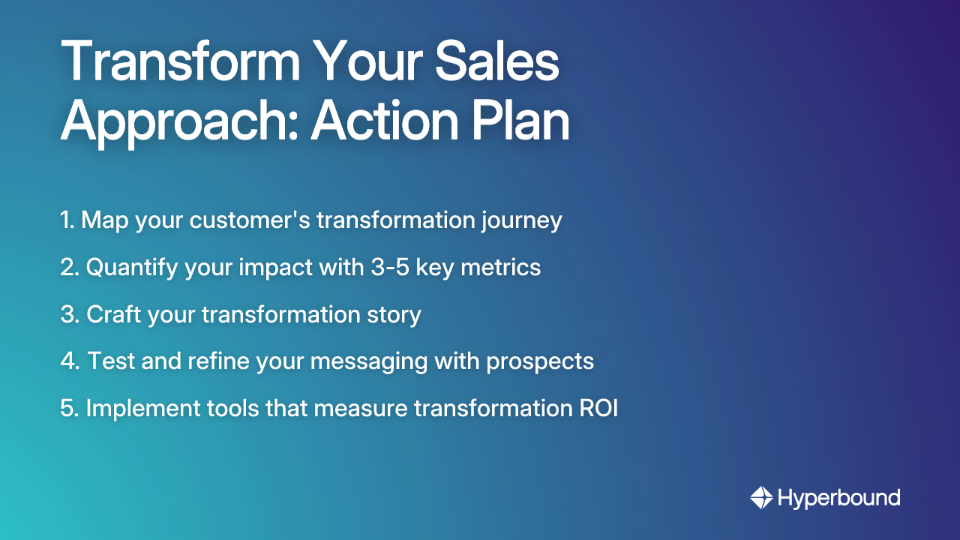
- Map the transformation: Complete the Before & After Grid for your primary customer persona.
- Quantify the impact: Identify 3-5 key metrics that demonstrate the value of your transformation.
- Craft your story: Use one of the storytelling frameworks to structure how you communicate about your product.
- Test and refine: Present your transformation-focused messaging to prospects and gather feedback.
- Equip your team to deliver: A powerful story is only effective if your sales team can tell it. Use a platform like Hyperbound to let reps practice their new messaging through AI roleplays. You can then measure how well they articulate value in real customer conversations, providing the data to prove the ROI of your new approach.
By focusing on transformations rather than features, you'll connect more deeply with customers, differentiate from competitors, and ultimately build more successful products that deliver genuine value.
Remember: People don't buy products. They buy better versions of themselves and their businesses. Show them that transformation, and you'll never have to "sell" again.

Frequently Asked Questions
What is the difference between selling features vs. transformations?
Selling features focuses on what a product does (e.g., "Our software has a reporting dashboard"), while selling transformations focuses on what the customer becomes (e.g., "You'll transform from a data-overwhelmed manager to a strategic leader with instant insights"). Transformations encompass the entire "before" to "after" journey, including changes in how customers feel, work, and are perceived.
Why is a transformation-focused approach better for sales?
A transformation-focused approach is more effective because it connects with the customer's fundamental needs and emotional drivers, which are the primary basis for buying decisions. While features are logical, transformations create a powerful vision of a better future that is more memorable and compelling than a simple list of capabilities, helping you stand out in a crowded market.
How do I define my product's customer transformation?
You can define your product's transformation by using the "Before & After Grid." This framework helps you map the customer's state before using your product and after. Consider what they have, how they feel, what their average day looks like, and their status. To get authentic insights, conduct customer interviews rather than relying on assumptions.
How can I quantify my product's value for customers?
Quantify your product's value by focusing on measurable outcomes. Key areas to measure include error reduction (e.g., decrease in manual data entry mistakes), time savings and efficiency (e.g., hours saved per week), cost savings (e.g., reduced labor costs or retired software subscriptions), and improvements in security or compliance. Concrete data makes the transformation tangible and proves your ROI.
What is the best way to tell a transformation story in a sales pitch?
The best way to tell a transformation story is to make the customer the hero. Frameworks like StoryBrand are effective for this, where you act as the "guide" helping the "hero" (customer) overcome a problem. Another effective method is the Four-Step Framework: explain a market change, name the customer's pain, acknowledge alternatives, and then communicate the gain your solution provides.
How do I balance talking about transformations and features in a demo?
In a demo, lead with the transformation and use features as proof points. Instead of starting with "Here is our dashboard," begin by describing the customer's current pain point, like "Many managers spend hours reconciling inventory." Then, introduce the feature by saying, "Let me show you how you can get that done in 30 seconds." This frames every feature within the context of solving a real problem and achieving the desired transformation.
Book a demo with Hyperbound


