.png)


.png)
Summary
- AI-powered follow-ups can improve response rates by 25%, reduce sales cycle time by 30%, and save reps over 11 hours of manual work per week.
- The future of outbound sales is a hybrid model where AI handles high-volume, repetitive tasks, allowing humans to focus on building relationships and closing high-value deals.
- To prepare, sales teams should adopt a workflow using AI for prospecting and initial outreach, then transitioning engaged leads to reps for closing.
- While automation generates leads, AI coaching platforms like Hyperbound ensure your reps are ready to convert those hard-won conversations into revenue.
You've set up a promising outbound sales campaign, crafted personalized emails for hundreds of prospects, and now you're drowning in a sea of follow-ups that need your attention. Your calendar is packed with reminders to "check in" with leads who haven't responded, and despite working overtime, you're still falling behind. The worst part? You know you're missing opportunities because you simply can't keep up with the volume.
Sound familiar? You're not alone.
"I feel completely overwhelmed and cannot effectively manage follow-ups due to time constraints," confessed one sales professional on Reddit. Another lamented their "struggle to find the right balance between automation and personal touch in follow-ups."
By 2026, these pain points will be relics of the past. A new generation of AI-powered tools is set to revolutionize how sales teams handle outbound follow-ups, creating a future where manual follow-up management is as outdated as the rolodex.
The Inefficiency of Manual Follow-Ups: A Numbers Game You Can't Win
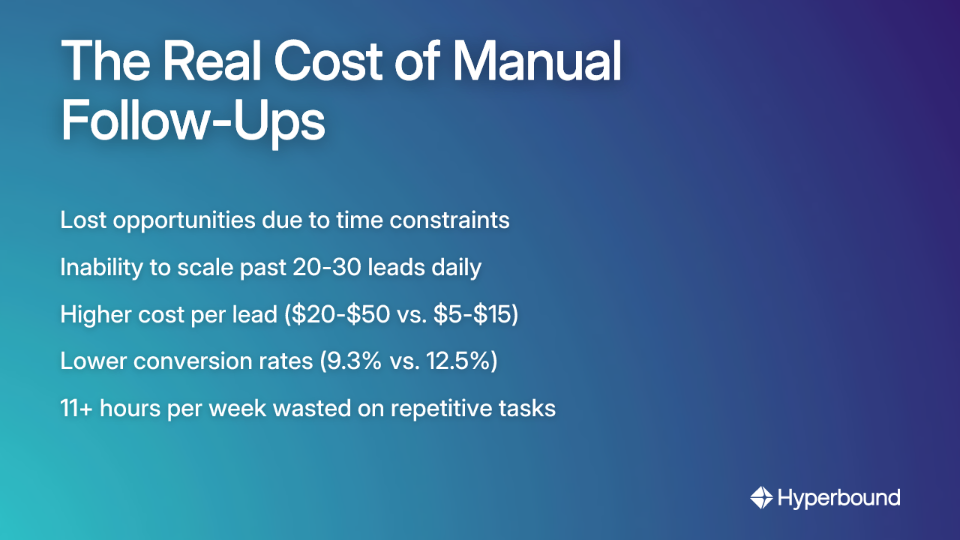
Let's be honest about what manual follow-ups really cost your business:
.png)
The math is simple and stark. Sales professionals using AI-driven automation save an average of 2 hours and 15 minutes daily—that's 11 hours per week freed up for strategic, relationship-building activities.
Beyond time, there's the scalability factor. Even the most dedicated sales rep can only personally manage a finite number of interactions. Meanwhile, the global sales automation market is projected to grow from $7.8 billion in 2019 to $16 billion by 2025 as companies recognize this fundamental limitation.
The most compelling statistic? Automation can improve response rates by 25% and reduce sales cycle time by 30%. These aren't marginal gains; they're transformative.
The Tech Revolutionizing Outbound Sales: Beyond Basic Scheduling
.png)
The tools replacing manual follow-ups in 2026 go far beyond simple email scheduling. They're powered by sophisticated technologies that fundamentally change what's possible in outbound sales:
Natural Language Processing (NLP)
This isn't about mail-merge personalization. Modern NLP analyzes prospect data to craft genuinely tailored messages that sound human. The days of obvious template-based outreach are ending as AI learns to write with nuance and context awareness.
Predictive Analytics
Rather than treating all leads equally, predictive analytics performs sophisticated lead scoring by identifying high-potential prospects and predicting buying intent. This allows sales teams to prioritize their efforts where they'll have the greatest impact.
Signal-Based Selling
Perhaps the most revolutionary approach is signal-based selling, where AI monitors a prospect's digital footprint (funding announcements, website visits, job changes) and triggers outreach at precisely the right moment. This proactive strategy represents a quantum leap beyond static drip campaigns.
The 2026 Sales Stack: Top Tools for Automated Outbound Follow-Ups
If you're feeling "overwhelmed by choices" when looking for the right sales engagement tool, you're not alone. Here's a curated guide to the tools that will dominate the 2026 landscape:
While automation handles the volume, the success of your sales team still hinges on their performance during live conversations. AI coaching platforms ensure your reps are ready for those critical moments when a lead finally engages.
1. Hyperbound
Best for: AI-powered sales coaching and readiness
Features: Leverages your team's winning behaviors to create hyper-realistic AI roleplays for practicing everything from cold calls to objection handling. Provides instant, objective feedback on both practice and real calls to reduce ramp time and drive consistent performance.
Pros: Scales effective coaching across the entire team, ensures consistent playbook adoption, and provides a safe space for reps to master their skills.
Cons: Focused on sales readiness and conversation intelligence, not outbound sequence automation.
Pricing: Contact for a demo.
2. Lindy
Best for: All-in-one autonomous AI for outbound sales
Features: Handles calls, emails, and CRM updates autonomously. Qualifies leads and summarizes conversations using a no-code workflow builder.
Pros: Centralizes the entire follow-up process with powerful integrations to Salesforce and HubSpot.
Cons: Phone call features are not included in the free plan.
Pricing: Free plan available; Pro at $49.99/month.
3. Apollo.io
Best for: AI-powered sales prospecting and B2B leads
Features: Massive contact database with AI for lead scoring, email writing, and optimizing outreach timing. Includes multichannel sequences with a built-in dialer.
Pros: Comprehensive prospecting and engagement platform.
Cons: Users report occasional data accuracy issues; advanced features come at a premium.
Pricing: Free and paid tiers starting at $59/user/month.
4. ActiveCampaign
Best for: AI-driven email outbound automation and drip campaigns
Features: AI-powered email campaigns with predictive sending and tailored content, plus a visual automation builder.
Pros: Powerful and intuitive email automation.
Cons: Can have a learning curve; pricing scales with contact list size.
Pricing: Starts at $29/month.
5. Salesforce Sales Cloud
Best for: Enterprise-level CRM automation for outbound sales
Features: Comprehensive CRM with integrated AI agents, basic coaching tools, and personalized outreach features.
Pros: Incredibly powerful and scalable.
Cons: Complexity and price can be prohibitive for smaller teams.
Pricing: Starts at $25/user/month.
6. PhantomBuster
Best for: AI-powered LinkedIn outreach
Features: No-code automation platform for creating multi-step prospecting workflows on LinkedIn.
Pros: Highly efficient for social selling.
Cons: Technical setup can be a barrier for some users.
Pricing: Starts at $69/month.
For sales professionals seeking established solutions, the community consensus points to Salesloft and Outreach as "somewhat pricier but definitely the leaders in the Sales Engagement space," according to Reddit users.
The Hybrid Blueprint: Finding the Perfect Balance
The future isn't about replacing humans with machines—it's about finding the optimal balance between AI efficiency and human connection. This hybrid approach combines the best of both worlds:
Where AI Excels:
- High-volume initial outreach: AI can manage hundreds of personalized first touches daily.
- Nurturing low-priority leads: Keep warm leads engaged without consuming valuable rep time.
- Data-driven optimization: AI can achieve up to 40% higher open rates through continuous testing and refinement.
Where Humans Still Dominate:
- Building genuine relationships: The nuanced emotional intelligence that closes complex deals.
- Handling negotiations: Navigating objections and customizing solutions.
- Managing high-value prospects: Providing white-glove service to your most promising opportunities.
Mastering these high-stakes conversations is where the real value is created. It's why top teams use AI coaching platforms like Hyperbound to ensure their reps are always prepared to turn an automated follow-up into a closed deal.
Manual, personalized emails can generate 2-3x higher quality replies—but only when targeted at the right prospects at the right time.
A Practical Hybrid Workflow for 2026
.png)
Here's how leading sales teams will structure their outbound processes in 2026:
1. Prospecting & Sourcing
Use tools like Apollo.io or Cognism for high intent lead scraping and building qualified prospect lists. As one sales professional noted on Reddit, "High intent lead scraping has changed the game for us, it requires lesser outreach but gets me more converted meetings" (Source).
2. Initial Outreach
Deploy an automated sequence using Lindy or ActiveCampaign with personalized email templates populated by AI. For top-tier prospects, have a human review and approve messages before sending.
3. Engagement & Follow-Up
- If a lead replies positively or shows high engagement: An SDR or AE takes over for a personalized, human-led conversation.
- If a lead is unresponsive: They remain in an automated nurturing drip campaign that includes periodic, value-add content.
4. Closing
The final stages of negotiation and closing are always handled by a sales rep to build trust and address nuanced concerns.
Implementing Your Automated Future: A Practical Guide
Ready to embrace this future? Here's how to get started:
1. Assess and Identify
Analyze your current sales process to pinpoint bottlenecks and repetitive tasks that are prime candidates for automation. Start by mapping out your entire follow-up process and identifying where sales reps are spending most of their time on low-value activities.
2. Choose Your Tools
Select scalable solutions that offer robust API integrations to fit into your existing tech stack. Don't just pick a tool; build a cohesive system where your CRM, email platform, and automation tools work seamlessly together.
3. Drive Adoption
Implement a change management plan. Provide thorough training to ensure your team understands not just how to use the tools, but why they benefit everyone. According to SuperAGI, 74% of sales professionals believe AI will redefine their roles, so education is key to reducing resistance.
4. Measure Success
Track key metrics beyond just closed deals:
- Efficiency: Emails sent, follow-ups automated
- Engagement: Open rates, reply rates, click-through rates
- Conversion: Meetings booked, deals closed
- Sentiment: Analyze reply content for customer satisfaction
Conclusion: The Future is an Empowered Sales Team
The shift from manual to automated follow-ups is inevitable. By 2026, the question won't be whether to automate but how intelligently you've implemented automation into your sales process.
The most successful teams will use a hybrid approach, letting AI handle scale and repetitive tasks while humans focus on relationship-building and strategic decision-making. This balanced approach yields a 10-20% boost in sales ROI according to SuperAGI research.
The future of outbound sales isn't about replacing people with machines. It's about empowering people with intelligent tools, freeing them from repetitive tasks to focus on what they do best: building relationships and closing deals.
Those who embrace this future now will have an insurmountable advantage over competitors still struggling with manual follow-ups in 2026.
Frequently Asked Questions
What is the main benefit of automating sales follow-ups?
The primary benefit of automating sales follow-ups is a significant increase in efficiency and scalability. This allows sales teams to manage more leads effectively, save valuable time, and focus on high-impact activities. By automating repetitive tasks, a sales professional can save over 11 hours per week, handle 100-150 leads daily (compared to 20-30 manually), and reduce sales cycles by up to 30%.
Will AI replace human sales representatives?
No, AI is not expected to replace human sales representatives. Instead, it will augment their capabilities by handling repetitive, time-consuming tasks. The future of sales is a hybrid model where AI manages high-volume outreach and data analysis, freeing up humans to focus on what they do best: building genuine relationships, handling complex negotiations, and closing strategic deals.
How does AI help personalize sales outreach at scale?
AI personalizes sales outreach by using Natural Language Processing (NLP) to analyze prospect data and craft genuinely tailored messages that go far beyond simple mail-merge techniques. Unlike static templates, AI-powered tools can understand context and nuance to write messages that sound human and resonate with the individual. This technology helps improve response rates by ensuring the right message reaches the right person at the perfect moment.
What is a hybrid sales workflow?
A hybrid sales workflow is a balanced approach that combines the efficiency of AI-powered automation with the skill of human sales reps. In this model, AI handles initial prospecting, lead scoring, and automated nurturing sequences. When a lead shows high engagement or responds positively, a human salesperson takes over to manage the nuanced conversation, handle objections, and close the deal. This ensures scalability without sacrificing the personal touch needed for high-value conversions.
When should a human take over from an automated follow-up sequence?
A human should take over from an automated sequence as soon as a lead shows high intent or engagement. This could be a positive reply to an email, repeated visits to a pricing page, or a specific question about your product. The goal of automation is to identify and warm up promising leads; once a prospect is engaged, the conversation requires the emotional intelligence and problem-solving skills of a human rep to build trust and close the deal.
How can my team get started with sales automation?
To get started with sales automation, begin by analyzing your current sales process to identify repetitive tasks and bottlenecks. Next, select a few scalable tools that integrate with your existing systems, such as a CRM or email platform. Finally, focus on team adoption by providing thorough training on how to use the tools and tracking key metrics like efficiency gains, engagement rates, and meetings booked to measure success.
Book a demo with Hyperbound


