.png)


.png)
You've built a talented sales team, you're hitting growth targets, and you're adding new reps every quarter. But there's a problem lurking beneath the surface: as your team grows, your once-effective coaching approach is struggling to scale. The personalized attention you could give each rep when you had a team of five simply isn't sustainable with a team of twenty-five.
This is the scaling coaching dilemma that sales leaders everywhere face. Your top performers continue to thrive, but the rest of your team shows inconsistent results, longer ramp times, and varying levels of playbook adherence. The one-on-one coaching model that worked so well in the early days has become a bottleneck for growth.
As one sales leader noted in a recent discussion: "I am looking for how to improve rep skill gaps not just on a deal or call. Then help me recommend what to change across all rep calls." This sentiment captures the essence of the coaching challenge at scale – moving beyond reactive, deal-specific advice to strategic skill development across the entire team.
Let's explore the five critical mistakes sales leaders make when trying to scale their coaching efforts, and how to fix them.
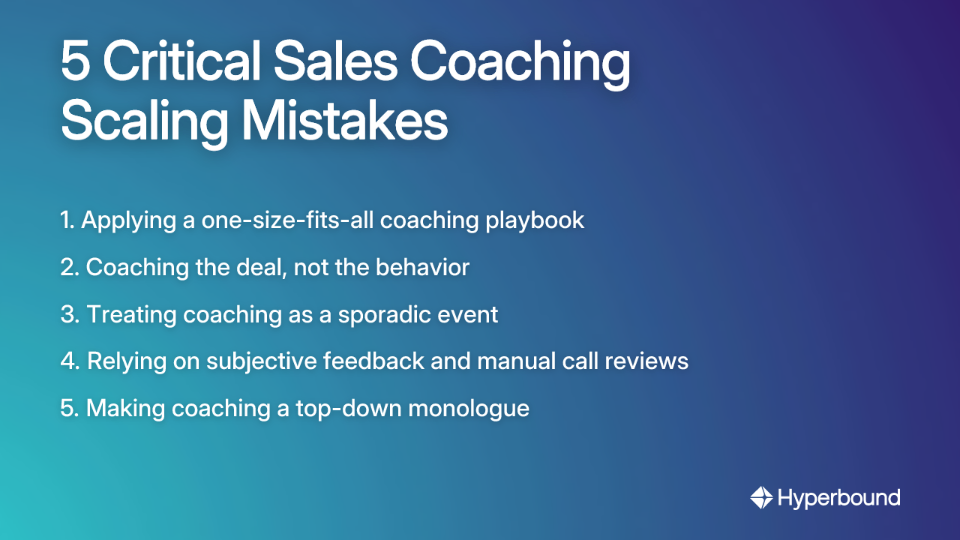
Mistake #1: Applying a One-Size-Fits-All Coaching Playbook
The Mistake: Rolling out generic, team-wide coaching that ignores the diverse needs, skills, and experience levels of individual reps.
Why It's a Trap: Creating a single training module or coaching topic feels efficient. It's easy to schedule a team training session and check the "coaching" box for the week. But this approach fails to address the root causes of underperformance for each individual.
The Real Cost: The consequences are significant:
- Disengagement: Tenured reps are bored by basic training, while new hires are overwhelmed by advanced topics.
- Inefficiency: Time is wasted coaching reps on skills they've already mastered or aren't ready for yet.
- Stagnation: Reps don't get the specific feedback needed to improve their unique weak spots.
A sobering statistic: only 26% of sales reps receive one-on-one coaching weekly. And when that rare coaching does happen, it's likely not personalized to their specific needs.
The Strategic Fix:
Instead of blanket training, personalize coaching by identifying and prioritizing 1-2 specific skill gaps for each rep. The recommendation is to use data from call recordings to pinpoint these gaps objectively, moving beyond a manager's gut feel to data-driven coaching plans.
How Technology Can Help:
Platforms like Hyperbound use AI Real Call Scoring to analyze every rep's calls against your sales methodology. This automatically surfaces individual weaknesses—whether in discovery, objection handling, or closing—allowing managers to create truly personalized coaching plans without having to listen to hours of calls. The technology identifies patterns that would be impossible to spot manually, giving managers the insights they need to coach strategically.
Mistake #2: Coaching the Deal, Not the Behavior
The Mistake: Coaching sessions that turn into pipeline reviews or deal-specific strategy sessions. The focus is on "what to do to close this deal" instead of "what skill to build to close more deals."
Why It's a Trap: It feels productive and directly impacts immediate revenue. Managers are often measured on their team's pipeline, making it the default topic of conversation. This mistake directly addresses the common frustration of needing to "improve rep skill gaps not just on a deal or call," as one sales leader put it.
The Real Cost:
- Creates Dependency: Reps learn to rely on their manager to solve problems instead of developing their own critical thinking and sales skills.
- Doesn't Scale: You fix one deal but the underlying behavioral issue (e.g., poor discovery) persists, reappearing in the next call with a different prospect.
- This is the difference between giving a rep a fish and teaching them how to fish.
The Strategic Fix:
Shift the focus of 1:1s from the pipeline to behaviors. Use "coaching sprints" to target one specific skill across the team for a few weeks. Use call snippets as examples to discuss the "how" and "why" behind successful (or unsuccessful) interactions.
How Technology Can Help:
Once a behavioral gap is identified, reps need a safe space to practice. Hyperbound's AI Sales Roleplays allow reps to practice specific skills—like handling pricing objections or executing a new talk track—in hyper-realistic simulations. This builds muscle memory for the desired behavior without risking live deals, creating a scalable way to transform behavior rather than just advising on individual deals.
Mistake #3: Treating Coaching as a Sporadic Event
The Mistake: Confining coaching to quarterly performance reviews, annual sales kick-offs, or occasional "emergency" sessions after a bad call.
Why It's a Trap: Without a formal coaching cadence, coaching becomes an "if I have time" activity that's easily pushed aside by more urgent tasks. It's treated as an event rather than an ongoing process.
The Real Cost:
- Forgetting Curve: Skills learned in one-off training events are quickly forgotten without reinforcement.
- Inconsistent Performance: A lack of consistent coaching leads to inconsistent messaging and execution across the team.
- Missed Opportunities: Waiting for scheduled reviews means coaching moments are lost in the moment they're most impactful.
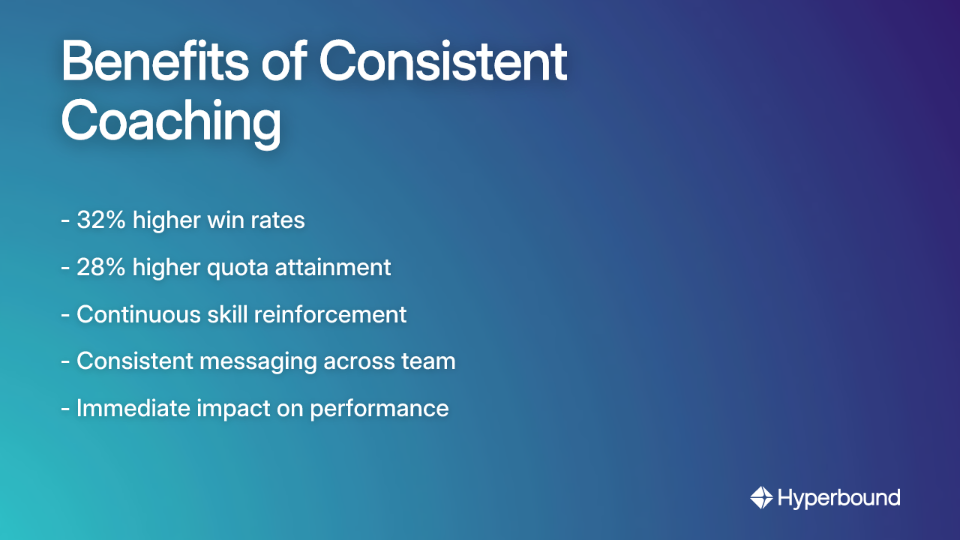
According to research, 80% of sales leaders admit they have no formal or consistent coaching process in place. Yet, studies show that companies with consistent coaching achieve 32% higher win rates and 28% higher quota attainment.
The Strategic Fix:
Integrate coaching into the daily and weekly rhythm of the sales floor. Make it a continuous process of feedback, practice, and reinforcement. Set up a regular cadence—such as weekly skill-focused sessions—and stick to it religiously.
How Technology Can Help:
AI can act as an "always-on" coach. Instead of waiting a week for manager feedback, reps can get it instantly. Hyperbound's AI Coaching feature delivers real-time feedback during or immediately after calls, flagging missed opportunities and reinforcing playbook adherence on every single conversation. This creates the continuous feedback loop necessary for true skill development.
Mistake #4: Relying on Subjective Feedback and Manual Call Reviews
The Mistake: Basing coaching on anecdotal evidence, a manager's personal opinion, or a small, biased sample of "spot-checked" calls.
Why It's a Trap: Managers have limited time and can't possibly listen to every call. This inevitably leads to subjective reviews and inconsistent feedback. Sales leaders in online discussions express the need for custom scorecards to ensure reps are "fully analyzed and aligned with your vision."
The Real Cost:
- Bias and Inconsistency: Feedback varies wildly from one manager to another. Reps on different teams get coached on different things.
- Blind Spots: Without analyzing all conversations, systemic issues that affect the entire team (e.g., a common objection that no one is handling well) are missed.
- Massive Time Sink: The manual process of finding calls, listening, and taking notes is a huge drain on manager productivity, preventing them from scaling their efforts.
The Strategic Fix:
Implement an objective, data-driven system for measuring call quality. Utilize conversation intelligence tools to analyze 100% of sales calls. Develop standardized scorecards based on your playbook to ensure every call is evaluated against the same criteria for success.
How Technology Can Help:
This is a core strength of AI-powered platforms. Hyperbound's AI Real Call Scoring automates the entire review process. It listens to every call and scores it against a fully customizable scorecard, providing objective, data-driven insights. The AI Deal Summary extracts key moments, saving managers hours and allowing them to coach strategically on patterns, not just anecdotes.
Mistake #5: Making Coaching a Top-Down Monologue
The Mistake: Coaching is delivered as a lecture from manager to rep, without empowering reps to own their development or learn from their peers.
Why It's a Trap: It's the traditional model of management. However, it fails to leverage the team's collective intelligence and makes the manager a bottleneck for all learning.
The Real Cost:
- Passive Learning: Reps are less engaged and less likely to internalize feedback they weren't involved in generating.
- Siloed Knowledge: The techniques of your top performers are never systematically shared, so the "middle 70%" of your team never learns from the best.
- Manager Burnout: Managers become the sole source of knowledge and skill development, which is unsustainable as the team grows.
The Strategic Fix:
Foster a culture of self-assessment and peer-to-peer learning. Encourage reps to review their own calls and come to 1:1s prepared to discuss what they think went well and what they could improve. Create a library of best-practice call recordings to be used as examples for the entire team.
How Technology Can Help:
Empowerment is key. Hyperbound's AI Sales Roleplays provide a self-service practice ground. A rep preparing for a renewal negotiation can practice with an AI Post-Sales Roleplay on their own time. This autonomy accelerates learning and builds confidence. The platform also surfaces top-performing calls, making it easy to create a "game tape" library for peer learning and celebrating wins.
Building a Scalable Coaching Culture
Avoiding these five mistakes isn't just about working harder at coaching—it's about building a smarter, technology-enabled system. It's about shifting from a reactive, manual process to a proactive, data-driven, and rep-empowering coaching culture.
When you make this shift, coaching transforms from a managerial chore into a strategic growth driver. Your reps develop faster, perform more consistently, and execute your playbook with precision. Most importantly, your coaching impact scales with your team, rather than becoming diluted as you grow.
Platforms like Hyperbound are designed specifically to help sales leaders build this modern coaching engine. By combining AI-powered call analysis, personalized feedback, and realistic practice environments, they enable you to reduce ramp time, drive consistent performance, and unlock your team's full potential—no matter how large your team becomes.
Ready to build a scalable coaching culture that grows with your team? Book a demo of Hyperbound today and see how AI can transform your coaching impact.
Frequently Asked Questions
What is the main problem with scaling sales coaching?
The main problem with scaling sales coaching is that traditional one-on-one methods become unsustainable and ineffective as a team grows. What works for a team of five creates a bottleneck for a team of twenty-five, leading to inconsistent performance and longer ramp times because managers cannot provide the same level of detailed, individualized guidance to everyone.
Why is personalized coaching better than a one-size-fits-all approach?
Personalized coaching is better because it addresses the specific, individual skill gaps of each sales rep, making it far more effective than generic, team-wide training. A one-size-fits-all approach often disengages experienced reps and overwhelms new hires. By focusing on the unique areas each rep needs to improve, coaching becomes more efficient and drives faster skill development.
How can I shift from coaching deals to coaching behaviors?
You can shift from coaching deals to behaviors by dedicating 1:1 sessions to specific skills rather than pipeline reviews and using call snippets to analyze how a rep handles situations. Instead of only asking "How can we close this deal?", focus on building repeatable skills that apply to all future deals, such as improving objection handling or discovery questions.
How often should sales coaching happen?
Effective sales coaching should be a continuous, ongoing process integrated into the daily and weekly rhythm of the sales team, not a sporadic event. While formal one-on-one sessions might happen weekly, coaching moments should be captured and addressed consistently. A regular cadence of feedback and practice leads to higher win rates and quota attainment.
How does AI improve sales coaching objectivity?
AI improves coaching objectivity by analyzing 100% of sales calls against a standardized, data-driven scorecard, removing managerial bias and subjective opinions. Instead of relying on a small sample of manually reviewed calls, AI provides consistent, unbiased data on every rep's performance, highlighting systemic issues and individual skill gaps that would otherwise be missed.
What is the role of AI sales roleplays in coaching?
AI sales roleplays provide a safe, scalable environment for reps to practice specific skills and behaviors without risking live deals. After a skill gap is identified, reps can use AI simulations to build muscle memory for handling new objections or delivering a new value proposition. This self-service practice accelerates learning and builds confidence.
What is the first step to building a scalable coaching culture?
The first step is to establish an objective, data-driven system for understanding your team's performance instead of relying on gut feel and manual call reviews. By implementing a tool that can analyze all conversations and pinpoint specific skill gaps for each rep, you lay the foundation for a scalable coaching program that drives real improvement as your team grows.

Book a demo with Hyperbound


