.png)


.png)
Summary
- Poor sales onboarding is a costly problem, with rep turnover costing up to 200% of their annual salary, yet only 12% of organizations excel at it.
- A structured 30-60-90 day framework is essential for success, moving reps from foundational knowledge to practical application and finally to performance autonomy.
- The most effective programs measure "Time to Competency"—mastery of core skills—rather than misleading metrics like "Time to First Deal."
- To accelerate skill mastery, sales teams use AI Sales Roleplays to give new hires unlimited, risk-free practice on critical sales conversations.
You've landed your new sales role, excited about the opportunity. But reality quickly sets in: Day one consists of being handed a list of tasks with no instructions on where to find the information. Your "training" is a vague suggestion to "spend a couple of hours looking at the courses." Three months in, you're still struggling to understand the product, the sales process, and the CRM system.
Sound familiar? You're not alone.
"90 days into my 1st Sales job and I haven't had any real or formal training. Day 1 consisted of a list of things to do with no instructions on where or how to get the info being requested," shares one frustrated sales rep on Reddit.
Another candidly admits: "I hated my job, A LOT because I was not given any sales training until I learned everything myself from books."
Meanwhile, the lucky few describe a completely different experience: "I had 7 (!!!!) weeks of onboarding and training. My company takes a ton of pride in its training."
The contrast is stark and troubling. Effective sales onboarding shouldn't be a lottery—it's a strategic imperative that directly impacts your success, satisfaction, and the company's bottom line.
The True Cost of Poor Onboarding
Poor onboarding isn't just frustrating—it's expensive. According to a Gallup study, replacing a single employee can cost between 50% to 200% of their annual salary. When you factor in recruitment, lost productivity, and the impact on team morale, the cost per departing rep can reach an astounding $97,000 to $115,000.
Yet despite these numbers, only 12% of employees strongly agree their organization does a great job of onboarding new employees.
So what does good sales onboarding actually look like? Let's break it down.
The Blueprint: A Structured Approach to Sales Onboarding
Pre-boarding: Before Day One
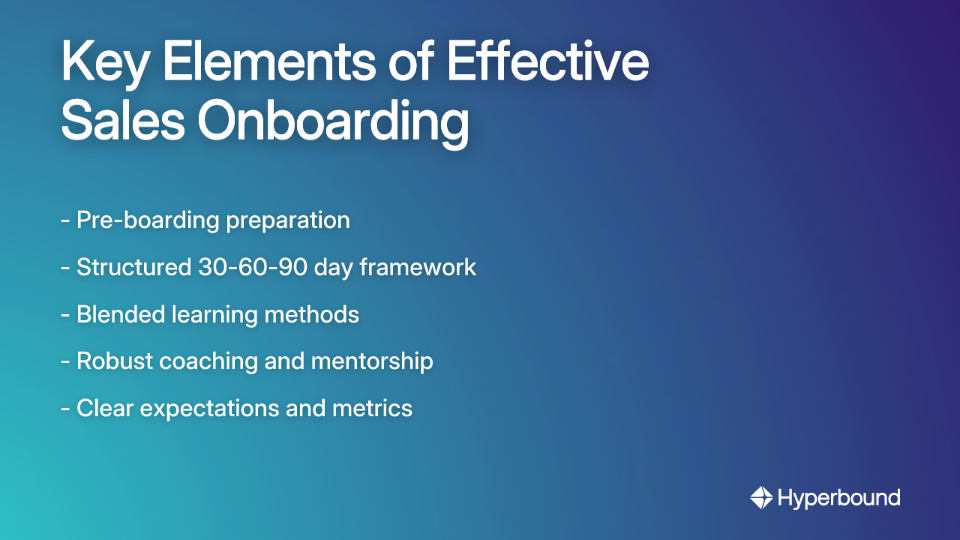
Effective onboarding begins before a new hire's first day. This critical phase sets the tone for the entire experience and includes:
- Completing administrative paperwork
- Shipping necessary equipment
- Providing login credentials
- Sharing foundational materials on company values and culture
- Introducing the Ideal Customer Profile (ICP)
This preparation demonstrates organizational competence and shows new hires they're valued from the start.
The 30-60-90 Day Framework
A structured timeline prevents information overload and creates clear milestones for progress. Here's what each phase should focus on:
First 30 Days: Foundation & Familiarization
Goal: Comprehending the fundamentals
Key Focus Areas:
- Company & Culture: Deep understanding of the mission, values, and team structure.
- Product Knowledge: Comprehensive dive into features, benefits, use cases, and pricing. This goes beyond surface-level understanding to explore how the product solves specific customer problems.
- Market & ICP: Thorough analysis of the industry, competitive landscape, and the customer's pain points. As one Reddit user emphasized: "Sales training should be about the market and the product. What's the market gap. How you solve it. Why you do it better than others. Why now."
- Sales Process: Introduction to the company's specific sales methodology (e.g., Sandler, Challenger) and pipeline stages.
- Tool Training: Hands-on training with the CRM and other key sales stack tools. This addresses the common frustration expressed by a rep who noted their company's software was "kinda convoluted and not straightforward like it should be" with "no official training on that."
Days 31-60: Application & Skill Development
Goal: Mastering tools and metrics
Key Focus Areas:
- Active Learning: Transition from theory to practice through application.
- Shadowing: Observe experienced reps on live calls and in meetings to see real-world application of techniques.
- Role-Playing: Practice pitching, handling objections, and running discovery calls in a safe environment. To scale this, many companies now use AI-powered role-playing tools like Hyperbound to simulate real-world scenarios and provide instant feedback.
- Initial Calls: Begin making calls with a manager or mentor listening in for immediate coaching and feedback.
Days 61-90: Integration & Performance
Goal: Advancing key skills and achieving autonomy
Key Focus Areas:
- Pipeline Management: Actively manage leads and opportunities, moving them through the sales cycle.
- Quota Responsibility: Begin carrying a ramped quota and be measured against performance KPIs.
- Advanced Skills: Focus on negotiation, closing techniques, and strategies for engaging C-suite stakeholders.
- Continuous Improvement: Establish regular feedback loops and coaching sessions to refine skills.
Best Practices That Separate Good Onboarding from Great
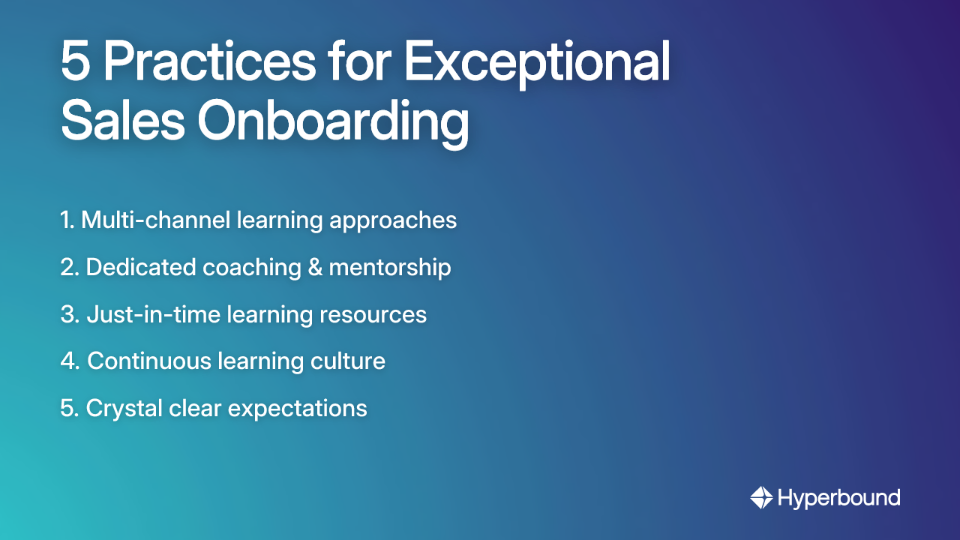
1. Blend Learning Methods (Omnichannel Learning)
Marathon PowerPoint sessions are ineffective. Research shows that 84% of sales training knowledge is forgotten within the first three months if not reinforced. Great programs use a mix of:
- Self-paced modules
- Live virtual classrooms
- One-on-one coaching
- Peer training
- Shadowing
This variety caters to different learning styles and improves retention.
2. Implement Robust Coaching & Mentorship
A dedicated sales coach or mentor is non-negotiable. This provides new hires with a safe space for questions and personalized feedback. The mentor should be someone who exemplifies success in the role and can offer both tactical advice and strategic guidance.
As one sales professional put it: "If you're not just open to coaching, but willing to apply it, we're just wasting O2." The best programs pair structured coaching with a rep's willingness to implement feedback. To scale this effort, AI coaching platforms like Hyperbound can supplement human coaching by providing reps with instant, objective feedback on practice roleplays and even live calls.
3. Deliver "Just-in-Time" Learning
Instead of front-loading all information, effective programs use tools that embed training content directly into the sales workflow. For example:
- Battle cards that pop up in the CRM when a competitor is mentioned
- Call scripts accessible during prospecting
- Objection handling guides available during client meetings
This approach addresses the problem of information being siloed in a Learning Management System (LMS) and not available when reps actually need it.
4. Foster a Culture of Continuous Learning ("Everboarding")
Onboarding shouldn't end at 90 days. Top organizations practice "Everboarding," providing ongoing training, skill development, and coaching to ensure reps continue to grow throughout their tenure. This might include:
- Regular product update sessions
- Advanced methodology training like Dale Carnegie Sales Advantage or Sandler Sales training
- Peer learning sessions where teams share best practices
5. Set Crystal Clear Expectations
From day one, reps should know exactly what success looks like. This includes clear definitions of their role, activity benchmarks, and performance goals. Without this clarity, new hires feel adrift and uncertain.
Measuring What Matters: Are Your Reps Actually Getting Better?
Traditional metrics like "Time to First Deal" or "Time to Quota" can be misleading. A rep might get lucky with a good lead or inherit a strong territory without actually mastering the necessary skills.
The Gold Standard: Time to Competency (TTC)
Time to Competency measures how long it takes for a new hire to acquire and demonstrate mastery of the core skills and knowledge required for their role. It focuses on capability, not just output.
Here's how it compares to traditional metrics:
.png)
A balanced scorecard approach includes both leading indicators (predictive measures) and lagging indicators (results):
Leading Indicators:
- Training completion rates
- Certification scores and pitch assessments
- Activity metrics (dials, emails, meetings booked)
Lagging Indicators:
- Time to first meeting booked / Time to first closed deal
- Ramp-to-sales-quota timeline
- Quota attainment rate
Demand More from Your Onboarding
Good sales onboarding isn't a "nice-to-have"—it's a strategic imperative. It's a structured, practical, and continuous process that is rigorously measured not just by deals closed, but by skills mastered.
Companies with standard onboarding processes see 50% greater new hire retention and significantly faster time to productivity. As one Reddit user candidly advised: "If any young people are reading this, bail ASAP if you don't receive sales training, don't even stay for a single month."
Whether you're a sales leader designing a program or a new rep evaluating a job offer, understand what excellence looks like. The difference between a great onboarding experience and a poor one is the difference between building a confident, high-performing career and feeling like you want to "cry finding all this out" when you realize what you've been missing.
Remember, when a company invests in robust sales onboarding, they're not just investing in their business—they're investing in you.
Frequently Asked Questions
What is sales onboarding?
Sales onboarding is the structured process of integrating a new sales representative into a company. It goes beyond basic training to equip them with the necessary knowledge, skills, and tools to become a successful and productive member of the sales team. This includes understanding the company culture, product, target customer, sales process, and performance expectations.
Why is a structured sales onboarding process important?
A structured sales onboarding process is crucial because it directly impacts employee retention, productivity, and company revenue. Effective onboarding reduces the time it takes for a new rep to become competent, increases job satisfaction, and can lead to 50% greater new hire retention. Conversely, poor onboarding is costly, leading to high turnover rates and lost productivity.
How long should a new sales rep's onboarding last?
While the exact duration can vary, a comprehensive sales onboarding program typically follows a 90-day framework. The first 30 days focus on foundational knowledge, days 31-60 are dedicated to practical application and skill development through activities like role-playing and shadowing, and days 61-90 involve full integration, performance measurement, and quota responsibility.
What are the key components of a successful sales onboarding program?
A successful sales onboarding program includes several key components. It should start with pre-boarding before day one, follow a structured 30-60-90 day plan, use a blend of learning methods (omnichannel learning), provide robust coaching and mentorship, offer just-in-time learning resources, and set crystal-clear performance expectations from the start.
How do you measure the effectiveness of sales onboarding?
The most effective way to measure sales onboarding is by focusing on "Time to Competency" (TTC), which tracks how long it takes a rep to master the core skills needed for their role. While traditional metrics like "Time to Quota" and "Time to First Deal" are useful, they can be misleading. A balanced approach uses leading indicators (like training completion and certification scores) and lagging indicators (like quota attainment) to get a full picture of a rep's progress.
What is the difference between sales onboarding and "Everboarding"?
Sales onboarding is the initial process, typically lasting around 90 days, designed to get new hires up to speed. "Everboarding," on the other hand, refers to the culture of continuous learning and development that extends beyond the initial onboarding period. It ensures that all sales reps, regardless of tenure, receive ongoing training, coaching, and skill development to adapt to new products, market changes, and advanced sales techniques.

Book a demo with Hyperbound


