.png)


.png)
You've put on your best business attire, practiced your pitch in the mirror, and confidently walked through the doors of a prospect's office. But instead of the warm welcome and productive conversation you envisioned, you're met with a dismissive receptionist, an unavailable decision maker, and that all-too-familiar feeling that you've just wasted another afternoon.
If this scenario sounds painfully familiar, you're not alone. Walk-ins fundamentally have a low ROI as a sales strategy, especially in today's B2B environment where gatekeepers are trained to filter out unsolicited visitors and decision makers have packed calendars.
"It's a giant waste of time," as many experienced sales professionals confess. Yet companies continue sending their teams into the field with little more than a list of addresses and a product brochure, expecting results from a strategy that's increasingly ineffective.
But what if there's a better way? What if the problem isn't walk-ins themselves, but rather how they're executed? This article breaks down why traditional sales walk-ins fail and provides five actionable strategies to transform your approach from cold, awkward encounters into warm, productive meetings.
The Anatomy of a Failed Walk-In
.png)
Before we can fix the problem, we need to understand exactly why walk-ins so often end in disappointment. Three fundamental issues plague the traditional approach:
The Low ROI Trap: Wasting Time, Money, and Morale
Cold walk-ins are notoriously inefficient with minimal returns on the considerable effort invested. The math simply doesn't work out:
- Time Wasted on Travel: A 30-minute drive to a prospect's location means an hour of selling time lost. Multiply this by several prospects a day, and suddenly a significant portion of your week disappears just getting from point A to B.
- Inefficient Conversations: When you do get in the door, the conversations are rarely productive. Your prospect isn't prepared for a meaningful discussion about their business challenges or your solutions, leading to superficial exchanges that rarely advance the sales process.
- Morale Killer: Constant rejection takes a toll. Even seasoned sales professionals can become disheartened after days of closed doors and "we're not interested" responses, affecting their motivation and performance across all activities.

The Gatekeeper Gauntlet
The person at the front desk represents the first and often insurmountable hurdle in your walk-in strategy.
"The gatekeeper has no incentive to help you; they are incentivized to help decision makers turn people away," notes one sales veteran on Reddit. Receptionists and administrative assistants serve as the first line of defense, designed specifically to block unsolicited sales pitches from reaching busy executives.
The fundamental problem is clear: you're pitching to someone who cannot say "yes" but has full authority to say "no." And in most organizations, that person is extremely good at their job of keeping unexpected visitors away from decision makers.
The Catastrophic Timing Problem
Perhaps the most obvious yet overlooked issue with walk-ins is the timing. Showing up unannounced virtually guarantees you're arriving at the wrong moment:
- Decision-Makers are Busy: Executives and department heads operate on tight schedules. Your surprise visit interrupts their workflow, making them immediately defensive or dismissive. As one business owner put it, "Unannounced walk-ins can anger prospects who are not used to receiving visitors."
- Prospects Aren't Prepared: Even if the decision-maker happens to be available, they aren't mentally prepared for your visit. A productive sales conversation requires context about their needs and your solution—an impromptu visit lacks this crucial foundation.
- You're Competing with Priorities: When you appear without warning, you're automatically lower priority than whatever the prospect was already doing. This creates an uphill battle for attention and engagement from the start.
5 Actionable Strategies to Turn Walk-Ins into Wins
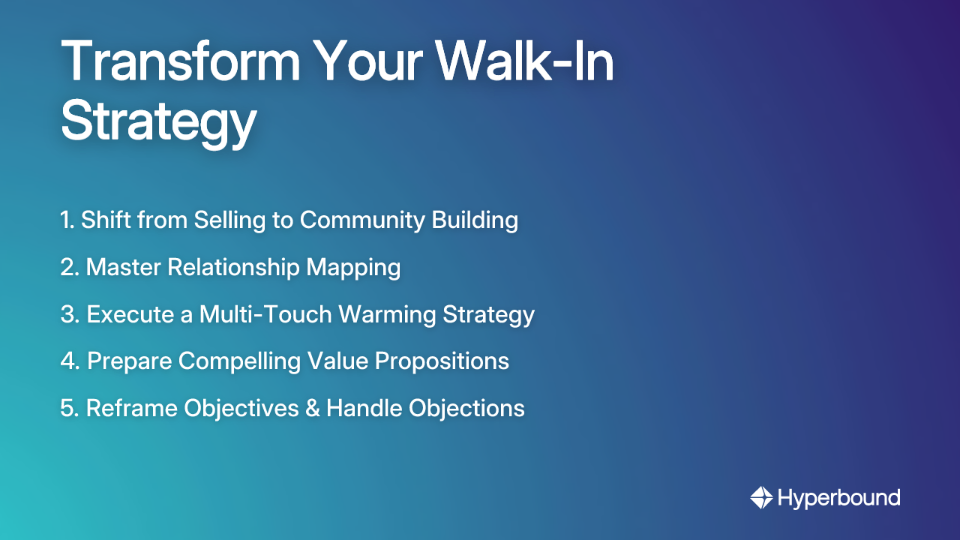
Now that we understand why traditional walk-ins fail, let's explore five proven approaches to transform this outdated strategy into a powerful tool for your sales arsenal.
1. Shift from Selling to Community Building
The most successful B2B sales professionals no longer think in terms of one-off transactions but rather in building meaningful connections within their target market.
Actionable Steps:
- Engage in Their World: Participate in industry events, webinars, and online forums where your prospects gather. Become a familiar face and name before you ever walk through their door. "Nothing beats face-time," notes one successful sales leader, "but that face-time is much more valuable when you've already established credibility."
- Provide Value First: Share insights, answer questions, and contribute to discussions without immediately pushing your product. Each interaction should deliver something useful to the prospect, positioning you as a resource rather than just another salesperson.
- Organize Community Events: Host educational workshops, networking events, or casual meetups for businesses in your target industry. These events create natural opportunities for warm conversations without the pressure of a direct sales pitch.
2. Master Relationship Mapping Before You Move
Never walk in blind. The most successful sales professionals thoroughly research and map the relationships within their target organizations.
Actionable Steps:
- Identify Key Decision-Makers and Influencers: Use LinkedIn and other professional platforms to understand the organizational structure. Identify not just the C-level executives, but also the managers and end-users who influence purchasing decisions.
- Understand Their Pain Points: Research recent company news, press releases, and social media activity of key personnel. This intel allows you to tailor your approach based on real business challenges they're facing.
- Create Relationship Maps: Document how decision makers connect to each other and to external partners or vendors. Understanding these relationships helps you identify potential allies and entry points into the organization.
3. Execute a Multi-Touch Strategy to Warm the Lead
A walk-in should never be your first touchpoint with a prospect. Instead, it should be a strategic step in a carefully orchestrated multi-channel outreach campaign.
Actionable Steps:
- Implement a Strategic Sequence:
- First Touch (Email): Send a personalized email referencing a specific company trigger or pain point.
- Second Touch (Social): Connect on LinkedIn and engage meaningfully with their content.
- Third Touch (Call): Make a brief call referencing previous touchpoints and attempting to schedule a meeting.
- Fourth Touch (Strategic "Walk-in"): Only after these previous touches should you consider an in-person visit, and when you do, you can reference your prior communications: "I sent you an email last week about improving your customer retention rates and was in the area..."
- Add Value at Each Touchpoint: Every interaction—whether email, social media engagement, phone call, or in-person visit—should provide something valuable to the prospect, from industry insights to relevant case studies.
- Track and Adjust: Use CRM tools to document each touchpoint and the prospect's response, allowing you to refine your approach based on what resonates.
4. Research and Prepare a Compelling Value Proposition
When you do finally walk in, you must be hyper-prepared with a value proposition that speaks directly to your prospect's specific needs and challenges.
Actionable Steps:
- Craft a Tailored Value Proposition: Develop a clear, concise statement that communicates exactly how your product or service addresses the prospect's specific pain points. Generic pitches fail; personalized value propositions succeed.
- Prepare Powerful Opening Statements: Instead of starting with "Do you have a minute?" use an industry insight or relevant observation. For example: "I noticed you recently expanded your print media campaign, and I thought you might be interested in how similar companies are boosting their ROI by integrating digital components."
- Bring Proof Points: Prepare case studies, testimonials, or data points that demonstrate your success with similar companies or in solving similar problems. Tangible proof makes your value proposition more credible and compelling.
5. Reframe Your Objective and Prepare for Objections
The goal of a first visit is not to make a sale; it's to qualify the prospect and set a formal appointment for a deeper conversation.
Actionable Steps:
- Set Realistic Visit Goals: Understand that the objective of an initial contact is simply to establish rapport, gather information, and secure a follow-up meeting—not close a deal.
- Anticipate and Prepare for Objections: Develop thoughtful responses to common objections like "we're happy with our current vendor" or "we don't have budget right now." Your preparation will help you navigate these obstacles smoothly. Practicing these scenarios in a safe environment using tools like Hyperbound's AI Sales Roleplays allows reps to build the confidence and muscle memory needed to handle them effectively in the field.
- Build Rapport with the Gatekeeper: Treat the receptionist or assistant with genuine respect and interest. "If you sound confident enough, the gatekeeper will be reluctant to question further and may put you through directly," advises one successful sales professional.
Transform Your Approach, Transform Your Results
The era of ambush-style cold walk-ins is over. Today's B2B sales environment requires a more strategic, thoughtful, and value-driven approach. By building community connections, mapping relationships, implementing multi-touch strategies, crafting compelling value propositions, and setting appropriate objectives, you can transform your walk-ins from awkward interruptions to welcomed conversations.
Remember: Success in modern sales isn't about forcing your way through the front door—it's about earning the right to be invited in. Shift your focus from selling products to building relationships and solving problems, and you'll find prospects far more receptive when you do walk through their doors.

Which of these five strategies will you implement this week to transform your approach from cold calls to warm conversations? Your next great client relationship might be just one strategic walk-in away.
Book a demo with Hyperbound


